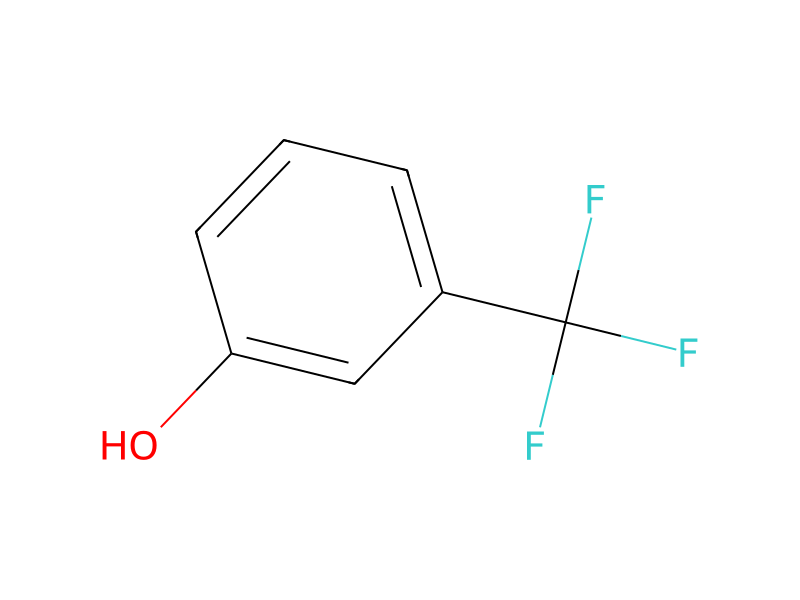
Cl[C:2]1[C:11]2[C:6](=[C:7]([I:13])[C:8]([CH3:12])=[CH:9][CH:10]=2)[CH:5]=[CH:4][N:3]=1.[F:14][C:15]([F:24])([F:23])[C:16]1[CH:17]=[C:18]([OH:22])[CH:19]=[CH:20][CH:21]=1.C(=O)([O-])[O-].[Cs+].[Cs+].CS(C)=O>O.C(OCC)(=O)C>[I:13][C:7]1[C:8]([CH3:12])=[CH:9][CH:10]=[C:11]2[C:6]=1[CH:5]=[CH:4][N:3]=[C:2]2[O:22][C:18]1[CH:19]=[CH:20][CH:21]=[C:16]([C:15]([F:14])([F:23])[F:24])[CH:17]=11-Chloro-5-iodo-6-methylisoquinoline (0.250 g, 0.824 mmol), 3-(trifluoromethyl)phenol (0.200 g, 1.24 mmol), cesium carbonate (0.590 g, 1.81 mmol) were all placed in a clear microwave vial along with 3 ml of DMSO. The vial was capped and heated in a Personal Chemistry SmithSynthesizer to 170° C. for 20 minutes. The reaction was diluted with water and ethyl acetate. The organic layer washed (2×) with an aqueous saturated solution of sodium bicarbonate, then with water and then brine. The organic layer was then dried with sodium sulfate and purified by column chromatography on silica gel using a gradient of 60-100% EtOAc in hexanes to give 5-iodo-6-methyl-1-(3-(trifluoromethyl)phenoxy)isoquinoline (0.260 g, 73.6% yield) as a white solid. MS (M+H)+ 430.