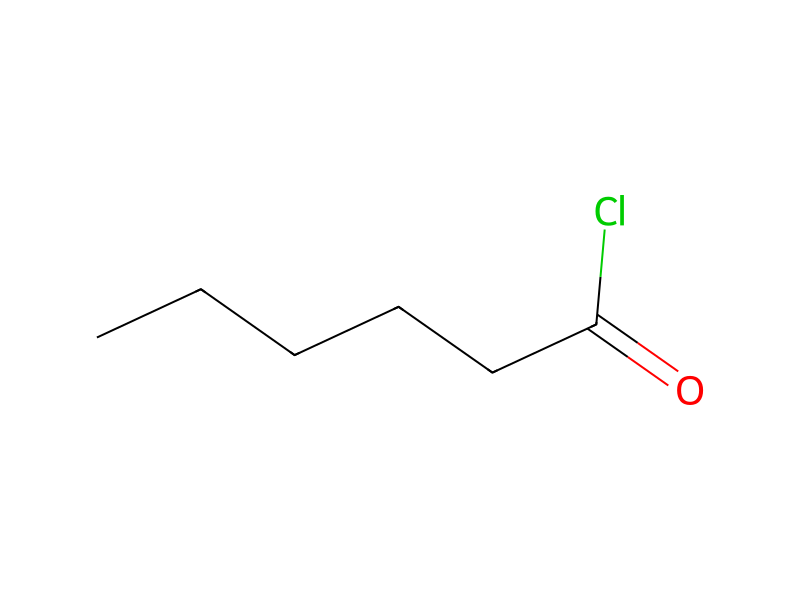
[C:1](Cl)(=[O:7])[CH2:2][CH2:3][CH2:4][CH2:5][CH3:6].[OH:9][CH2:10][N:11]1[C:20]2[C:19](=[O:21])[N:17]([CH3:18])[C:16](=[O:22])[N:15]([CH3:23])[C:14]=2[N:13]=[CH:12]1.C(N(CC)CC)C.CCCCCCC.C(Cl)Cl>C(Cl)Cl>[C:1]([O:9][CH2:10][N:11]1[C:20]2[C:19](=[O:21])[N:17]([CH3:18])[C:16](=[O:22])[N:15]([CH3:23])[C:14]=2[N:13]=[CH:12]1)(=[O:7])[CH2:2][CH2:3][CH2:4][CH2:5][CH3:6]To 0.71 g (0.0053 mole) of hexanoyl chloride in 10 ml of CH2Cl2 there was added 1.10 g (0.0052 mole) of 7-hydroxymethyl theophylline; no reaction occurred and the reaction mixture was a suspension. Then 0.58 g (0.0057 mole) of triethylamine was added and a clear, colorless solution was obtained. The solution was stirred at room temperature for 15 minutes then concentrated in vacuo. The residue was titrated with 200 ml ether and filtered. The filtrate was concentrated in vacuo to give an oil which was titrated with heptane CH2Cl2 (50:10). The resulting suspension was filtered while hot and concentrated to 20 ml, then cooled to room temperature. A gelatinous mass precipitated which was filtered and dried to give 0.70 g (mp 67°-72° C., 43% yield) of the desired product.
Loading…