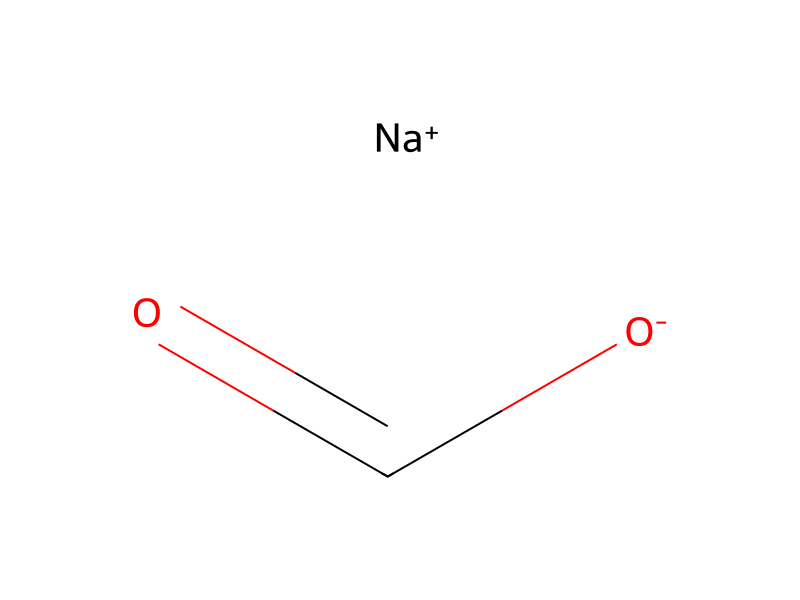
Sodium Formate → 1-Benzoylazo-2,2-dichloroethylene
HRID 1680651
Reaction equation

[C:1]([NH:9][N:10]=[CH:11][C:12](Cl)([Cl:14])[Cl:13])(=[O:8])[C:2]1[CH:7]=[CH:6][CH:5]=[CH:4][CH:3]=1.C([O-])=O.[Na+]>CC(C)=O>[C:1]([N:9]=[N:10][CH:11]=[C:12]([Cl:13])[Cl:14])(=[O:8])[C:2]1[CH:3]=[CH:4][CH:5]=[CH:6][CH:7]=1Participants
4
Reactant 2

Product 1

Reagents, catalysts & solvents 1

Procedure
14 g of N-benzoyl-N'-(2,2,2-trichloroethylidene) hydrazine was dissolved in 350 ml of acetone, to which was added 5.0 g of sodium formate, followed by stirring at room temperature for 2 hours to obtain a red reaction mixture. The acetone was distilled off under reduced pressure and the residue was subjected to extraction with benzene. The benzene layer was washed with water, dried and subjected to distillation to remove the solvent to obtain 9.7 g of dark red, oily 1-benzoylazo-2,2-dichloroethylene (at 80% of the theoretical).