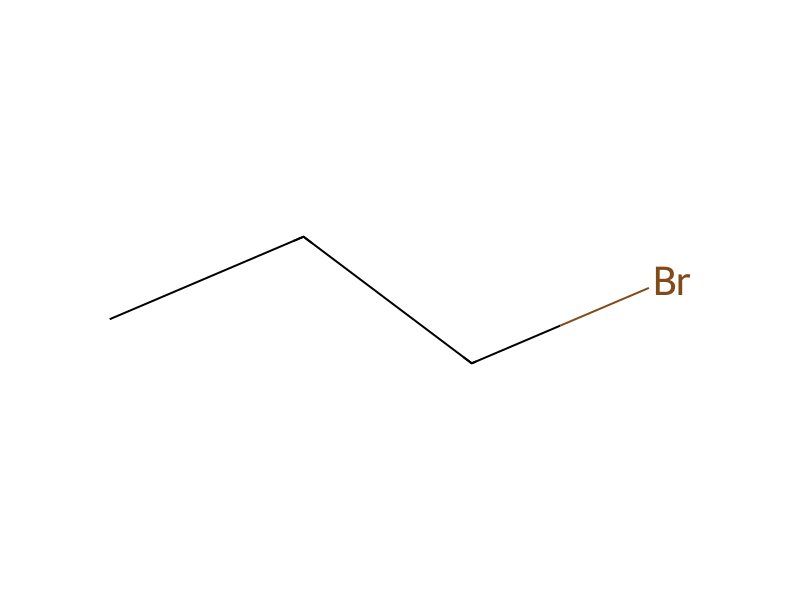
1-Bromopropane → 2-(3,5-Dimethyl-4-propoxyphenyl)-4,4,5,5-tetramethyl-1,3,2-dioxaborolane
Reaction equation

[CH3:1][C:2]1[CH:7]=[C:6]([B:8]2[O:12][C:11]([CH3:14])([CH3:13])[C:10]([CH3:16])([CH3:15])[O:9]2)[CH:5]=[C:4]([CH3:17])[C:3]=1[OH:18].Br[CH2:20][CH2:21][CH3:22].C([O-])([O-])=O.[K+].[K+]>CC(C)=O>[CH3:17][C:4]1[CH:5]=[C:6]([B:8]2[O:12][C:11]([CH3:13])([CH3:14])[C:10]([CH3:16])([CH3:15])[O:9]2)[CH:7]=[C:2]([CH3:1])[C:3]=1[O:18][CH2:20][CH2:21][CH3:22]Participants
5




Procedure
A mixture 2,6-Dimethyl-4-(4,4,5,5-tetramethyl-[1,3,2]dioxaborolan-2-yl)-phenol (500 mg, 2.02 mmol, 1 eq.), 1-bromopropane (793 mg, 6.45 mmol, 3.2 eq.), and K2CO3 (334 mg, 2.42 mmol, 1.2 eq.) in acetone (20 mL) is heated at 65° C. for 4 days. After cooling to room temperature, the reaction is concentrated, diluted with EtOAc and sequentially washed with H2O and saturated aqueous NaCl. The organic solution is dried over Na2SO4 and concentrated to give 2-(3,5-Dimethyl-4-propoxy-phenyl)-4,4,5,5-tetramethyl-[1,3,2]dioxaborolane as a clear oil.
Workup
- concentrationthe reaction is concentrated
- additiondiluted with EtOAc
- washsequentially washed with H2O and saturated aqueous NaCl
- dry with materialThe organic solution is dried over Na2SO4
- concentrationconcentrated
Sources & evidence
- ORD record
- ord-2d6f8e605e434f208aef6342a71d9c6a
- Source dataset
- uspto-grants-2012_04
- Patent number
- US08153671B2
Reaction notes
Loading…