Reaction equation
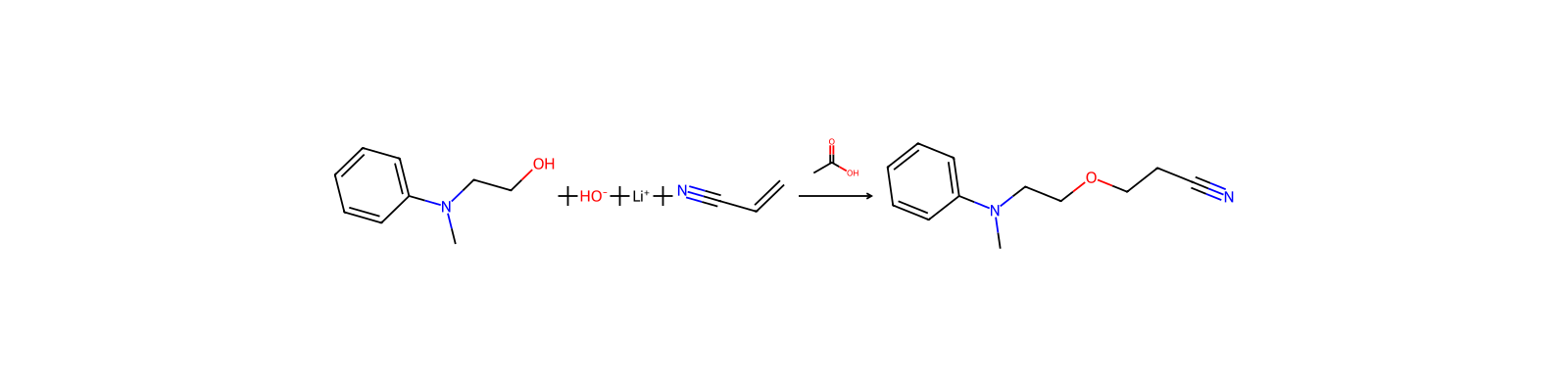
[OH:1][CH2:2][CH2:3][N:4]([CH3:11])[C:5]1[CH:10]=[CH:9][CH:8]=[CH:7][CH:6]=1.[OH-].[Li+].[C:14](#[N:17])[CH:15]=[CH2:16]>C(O)(=O)C>[C:14]([CH2:15][CH2:16][O:1][CH2:2][CH2:3][N:4]([CH3:11])[C:5]1[CH:10]=[CH:9][CH:8]=[CH:7][CH:6]=1)#[N:17]Participants
Reactant 3


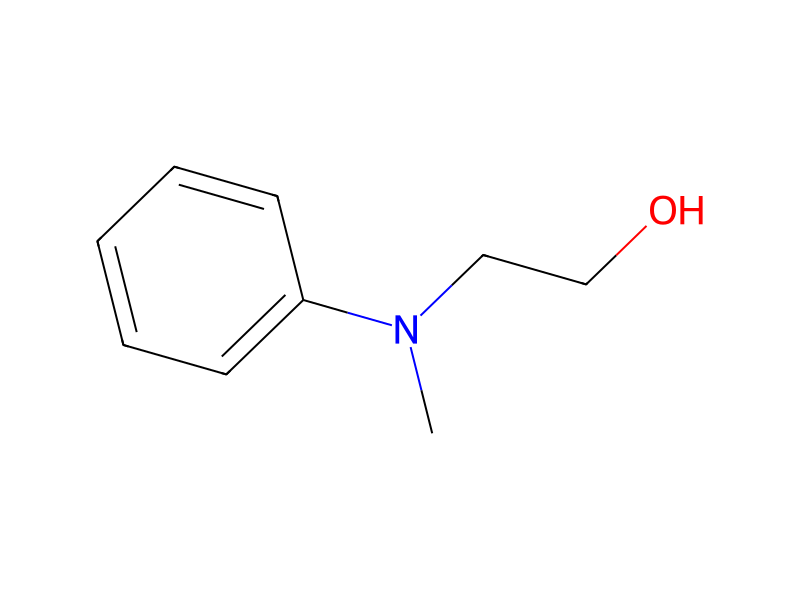
Product 1

Reagents, catalysts & solvents 1

Conditions
- Temperature
- 50 °C
Procedure
In a one-gallon autoclave was charged 1019 gm (6.75 moles) of hydroxyethylmethylaniline, 3 gm of anhydrous lithium hydroxide, and 532 gm (10 moles) of acrylonitrile. The autoclave was sealed and slowly heated to 50° C. until the initial exotherm was over. The reaction was then heated to 65°-70° C. for 6 hours. The reaction contents were cooled to room temperature and made slightly acidic with acetic acid. The reaction contents were then filtered. The crude filtered reaction product was stripped of all excess acrylonitrile under vacuum (15-30 mm Hg) at a temperature not exceeding 80° C. to give the orange liquid, 2-cyanoethoxyethylmethylaniline. Liquid chromatography showed the product to be about 97.4% purity. The IR, NMR, and GC mass spectra of the product were consistent with 2-cyanoethoxyethylmethylaniline.
Workup
- customThe autoclave was sealed
- temperatureThe reaction was then heated to 65°-70° C. for 6 hours
- customThe reaction contents
- temperaturewere cooled to room temperature
- customThe reaction contents
- filtrationwere then filtered
- filtrationThe crude filtered
- customreaction product
- customexceeding 80° C.
Sources & evidence
- ORD record
- ord-4e6004a95ea4413c926852d1deb39623
- Source dataset
- uspto-grants-1983_04
- Patent number
- US04381265
Linked notes
Loading…