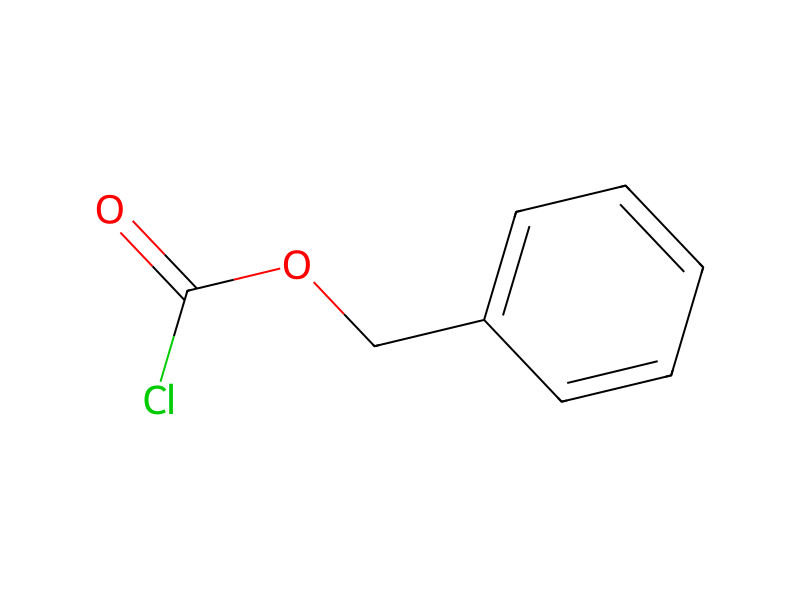
Benzyl chloroformate → 2-[(Benzyloxy)carbonyl]-1,2,3,4-tetrahydroisoquinoline-3-carboxylic acid
HRID 1732023
Reaction equation

[CH2:1]1[C:10]2[C:5](=[CH:6][CH:7]=[CH:8][CH:9]=2)[CH2:4][CH:3]([C:11]([OH:13])=[O:12])[NH:2]1.[C:14](Cl)(=[O:23])[O:15][CH2:16][C:17]1[CH:22]=[CH:21][CH:20]=[CH:19][CH:18]=1>[OH-].[Na+]>[C:14]([N:2]1[CH:3]([C:11]([OH:13])=[O:12])[CH2:4][C:5]2[C:10](=[CH:9][CH:8]=[CH:7][CH:6]=2)[CH2:1]1)([O:15][CH2:16][C:17]1[CH:22]=[CH:21][CH:20]=[CH:19][CH:18]=1)=[O:23]Participants
4



Procedure
188 g (1.05 moles) of 1,2,3,4-tetrahydroisoquinoline-3-carboxylic acid were added to 1,050 ml of 1N NaOH at 0° and then at this temperature, 100 ml of benzyl chlorocarbonate and a further 1,050 ml of 1N NaOH were added dropwise simultaneously. The mixture was then stirred at room temperature for 2 hours, then extracted three times with ether and acidified with concentrated HCl to pH 1. The oil which separated out was extracted into ethyl acetate. The ethyl acetate solution was washed with water until the water phase had a pH of 3. After drying, the product crystallized on evaporation and scratching. 1.5 liters of diisopropyl ether were added and the mixture was stirred at room temperature for one hour. The product was then filtered off with suction; melting point 138°-139°.