Chlorotrimethylsilane → 3,8-Dioxa-2,9-disiladecane, 2,2,9,9-tetramethyl-
HRID 1740329
Reaction equation
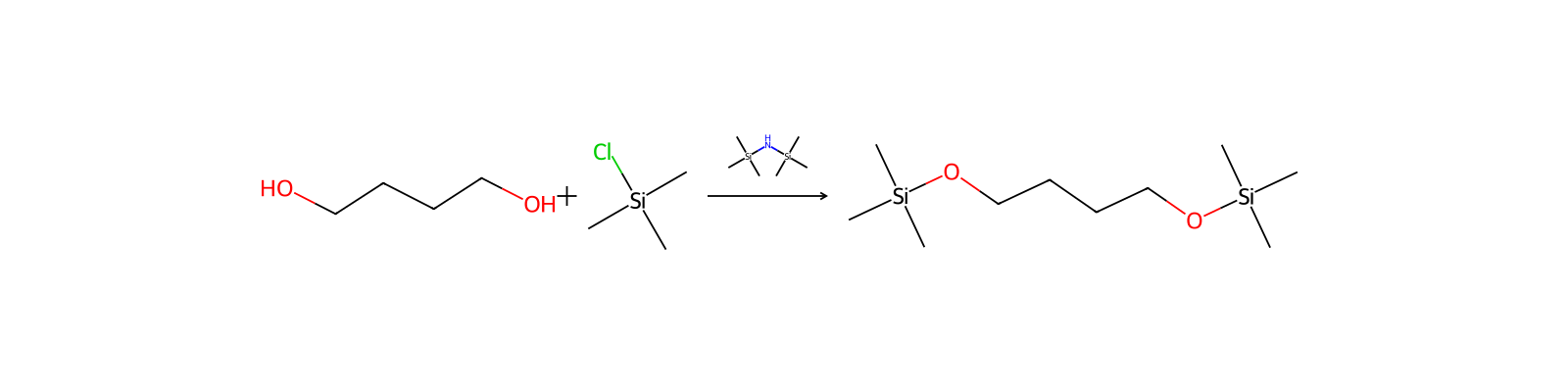
[CH2:1]([OH:6])[CH2:2][CH2:3][CH2:4][OH:5].[CH3:7][Si:8](Cl)([CH3:10])[CH3:9]>C[Si](N[Si](C)(C)C)(C)C>[Si:8]([O:5][CH2:4][CH2:3][CH2:2][CH2:1][O:6][Si:8]([CH3:10])([CH3:9])[CH3:7])([CH3:10])([CH3:9])[CH3:7]Participants
4
Reactant 2

Product 1
Reagents, catalysts & solvents 1

Conditions
- Temperature
- 50 °C
Procedure
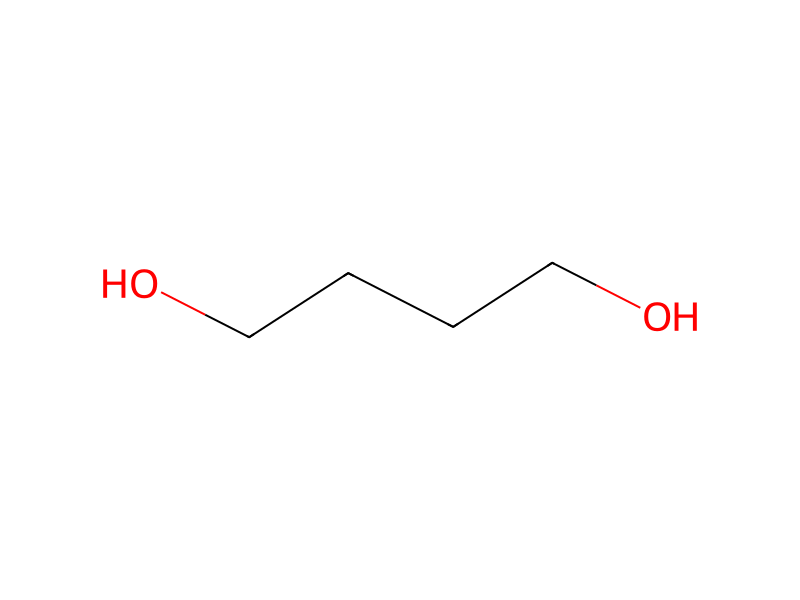
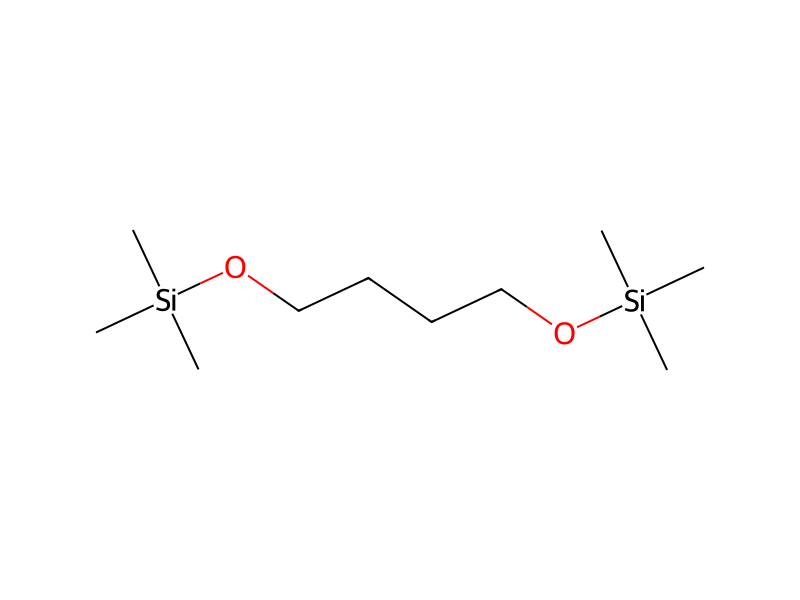
1,4-Butanediol (54 g, 0.60 mol) was placed in a 500 mL 3-necked RB flask and treated with 0.3 mL trimethylsilyl chloride. A portion of HMDS (ca. 20 mL) was added, and an exothermic reaction took place as the mixture became homogeneous. The remainder of the HMDS (120 mL, 0.66 mol total) was added at a controlled rate (ca. 3-5 mL/min), maintaining the reaction temperature at ca. 50° C. Heating was continued at 100° C. (3 h), and 150° C. (1.5 h). GC analysis (method 1) revealed excess HMDS and one product. Distillation provided 127.8 g of colorless oil, bp 97-99° C./15 mm. 1H NMR (CDCl3): 3.75-3.50 (m, 4 H), 1.75-1.50 (m, 4 H), 0.16 (s, 18 H).