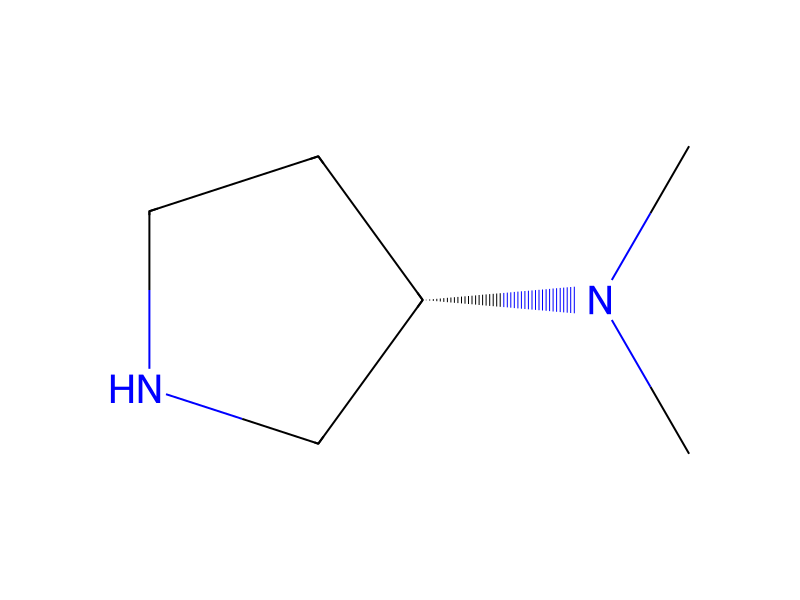
[CH3:1][N:2]([CH3:8])[C@H:3]1[CH2:7][CH2:6][NH:5][CH2:4]1.C(N(CC)CC)C.F[C:17]1[C:18]([C:38]2[CH:43]=[CH:42][CH:41]=[CH:40][CH:39]=2)=[C:19]([CH3:37])[C:20]([C:35]#[N:36])=[C:21]2[C:25]=1[O:24][C:23]([C:26]1[CH:31]=[CH:30][CH:29]=[CH:28][C:27]=1[N+:32]([O-:34])=[O:33])=[N:22]2>CS(C)=O>[CH3:1][N:2]([CH3:8])[C@H:3]1[CH2:7][CH2:6][N:5]([C:17]2[C:18]([C:38]3[CH:39]=[CH:40][CH:41]=[CH:42][CH:43]=3)=[C:19]([CH3:37])[C:20]([C:35]#[N:36])=[C:21]3[C:25]=2[O:24][C:23]([C:26]2[CH:31]=[CH:30][CH:29]=[CH:28][C:27]=2[N+:32]([O-:34])=[O:33])=[N:22]3)[CH2:4]1(3S)-3-(Dimethylamino)pyrrolidine (90 μl, 0.71 mmol) and triethylamine (200 μl) were added to a dimethyl sulfoxide (5 ml) solution of 7-fluoro-5-methyl-2-(2-nitrophenyl)-6-phenyl-1,3-benzoxazole-4-carbonitrile (I-210) (204 mg, 0.55 mmol). The system was purged with nitrogen, then sealed up, and heated at 100° C. for 1.5 hours. After cooling, the solvent was evaporated away under reduced pressure, then the resulting residue was dissolved in chloroform, and washed with water and saturated brine. The organic layer was dried over anhydrous sodium sulfate, then the solvent was evaporated away under reduced pressure, and the resulting residue was subjected to silica gel column chromatography. Elution with a mixed solvent of chloroform/methanol (98:2, v/v) gave a main product. This was washed with a mixed solvent of isopropyl ether and ethanol, and the solid was collected by filtration to obtain the entitled compound (137 mg, 54%) as a yellow solid.
Loading…