Reaction equation
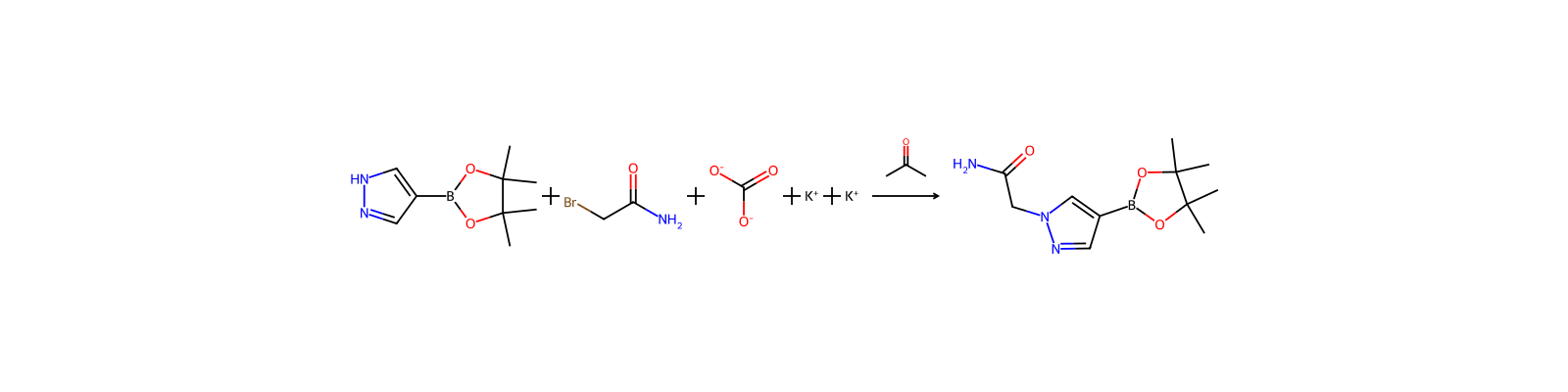
[CH3:1][C:2]1([CH3:14])[C:6]([CH3:8])([CH3:7])[O:5][B:4]([C:9]2[CH:10]=[N:11][NH:12][CH:13]=2)[O:3]1.Br[CH2:16][C:17]([NH2:19])=[O:18].C(=O)([O-])[O-].[K+].[K+]>CC(C)=O>[CH3:1][C:2]1([CH3:14])[C:6]([CH3:7])([CH3:8])[O:5][B:4]([C:9]2[CH:13]=[N:12][N:11]([CH2:16][C:17]([NH2:19])=[O:18])[CH:10]=2)[O:3]1Participants




Conditions
- Temperature
- 50 °C
Procedure
A suspension of 4-(4,4,5,5-tetramethyl-1,3,2-dioxaborolan-2-yl)-1H-pyrazole (2.00 g, 10.3 mmol), 2-bromoacetamide (2.14 g, 15.5 mmol), and potassium carbonate (2.14 g, 15.5 mmol) in acetone (60 mL) was heated at about 50° C. for about 3.5 days. The reaction mixture was then cooled to ambient temperature, filtered through diatomaceous earth, while washing with additional acetone, and then concentrated under reduced pressure. The crude material was then dissolved in a minimal amount of dichloromethane and purified via silica gel chromatography eluting with a gradient of 80-100% ethyl acetate in heptane to afford the title compound. 1H NMR (400 MHz, DMSO-d6) δ ppm 7.88 (s, 1H), 7.57 (s, 1H), 7.46 (s, 1H), 7.24 (s, 1H), 4.77 (s, 2H), 1.26 (s, 12H). MS (ESI+) m/z 252.2 (M+H)+.
Workup
- temperatureThe reaction mixture was then cooled to ambient temperature
- filtrationfiltered through diatomaceous earth
- washwhile washing with additional acetone
- concentrationconcentrated under reduced pressure
- dissolutionThe crude material was then dissolved in a minimal amount of dichloromethane
- custompurified via silica gel chromatography
- washeluting with a gradient of 80-100% ethyl acetate in heptane
Sources & evidence
- ORD record
- ord-ae4889e1f97041278ba99d4f3d34ae01
- Source dataset
- uspto-grants-2015_10
- Patent number
- US09163007B2
Linked notes
Loading…