Reaction equation
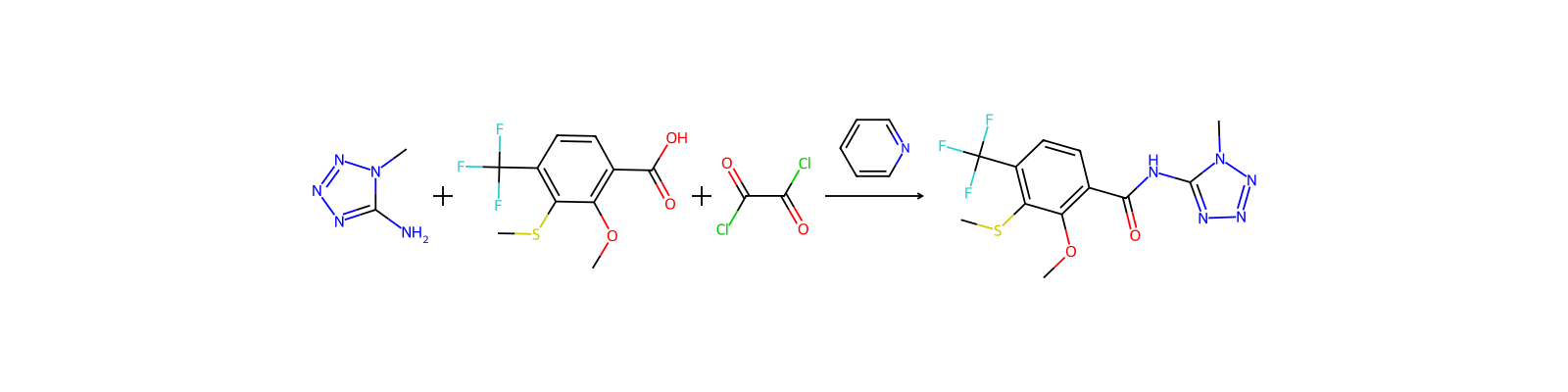
[NH2:1][C:2]1[N:6]([CH3:7])[N:5]=[N:4][N:3]=1.[CH3:8][O:9][C:10]1[C:18]([S:19][CH3:20])=[C:17]([C:21]([F:24])([F:23])[F:22])[CH:16]=[CH:15][C:11]=1[C:12](O)=[O:13].C(Cl)(=O)C(Cl)=O>N1C=CC=CC=1>[CH3:8][O:9][C:10]1[C:18]([S:19][CH3:20])=[C:17]([C:21]([F:24])([F:23])[F:22])[CH:16]=[CH:15][C:11]=1[C:12]([NH:1][C:2]1[N:6]([CH3:7])[N:5]=[N:4][N:3]=1)=[O:13]Participants
Reactant 3



Product 1

Reagents, catalysts & solvents 1

Procedure
1.45 g (98% by weight; 14.3 mmol) of 5-amino-1-methyl-1H-tetrazole were added to 3.00 g (11.3 mmol) of 2-methoxy-3-(methylsulfanyl)-4-(trifluoromethyl)benzoic acid in 30 ml of dry pyridine. 2.00 g (15.8 mmol) of oxalyl chloride were then added, and the mixture was subsequently stirred at room temperature (RT) for three days. Another 500 mg (3.94 mmol) of oxalyl chloride were then added, and the mixture was subsequently stirred at RT for 16 h. For work-up, the contents were substantially freed from the solvent on a rotary evaporator. The residue was stirred with dichloromethane and a saturated solution of sodium bicarbonate. The organic phases were then separated and the organic phase was freed from the solvent on a rotary evaporator. The residue was purified chromatographically, which gave 1.83 g of clean product.
Workup
- stirringthe mixture was subsequently stirred at RT for 16 h
- customFor work-up, the contents were substantially freed from the solvent on a rotary evaporator
- stirringThe residue was stirred with dichloromethane
- customThe organic phases were then separated
- customthe organic phase was freed from the solvent on a rotary evaporator
- customThe residue was purified chromatographically
Sources & evidence
- ORD record
- ord-6e42f933ffe44b92a03fe1941df17cc5
- Source dataset
- uspto-grants-2015_10
- Patent number
- US09167819B2
Linked notes
Loading…