Reaction equation
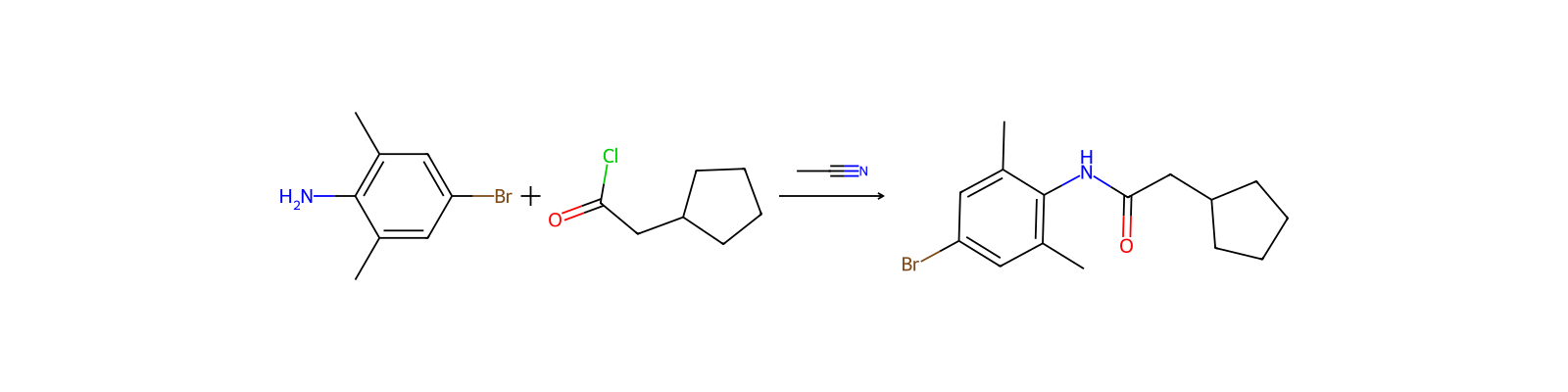
[Br:1][C:2]1[CH:8]=[C:7]([CH3:9])[C:5]([NH2:6])=[C:4]([CH3:10])[CH:3]=1.[CH:11]1([CH2:16][C:17](Cl)=[O:18])[CH2:15][CH2:14][CH2:13][CH2:12]1>C(#N)C>[Br:1][C:2]1[CH:8]=[C:7]([CH3:9])[C:5]([NH:6][C:17](=[O:18])[CH2:16][CH:11]2[CH2:15][CH2:14][CH2:13][CH2:12]2)=[C:4]([CH3:10])[CH:3]=1Participants
4
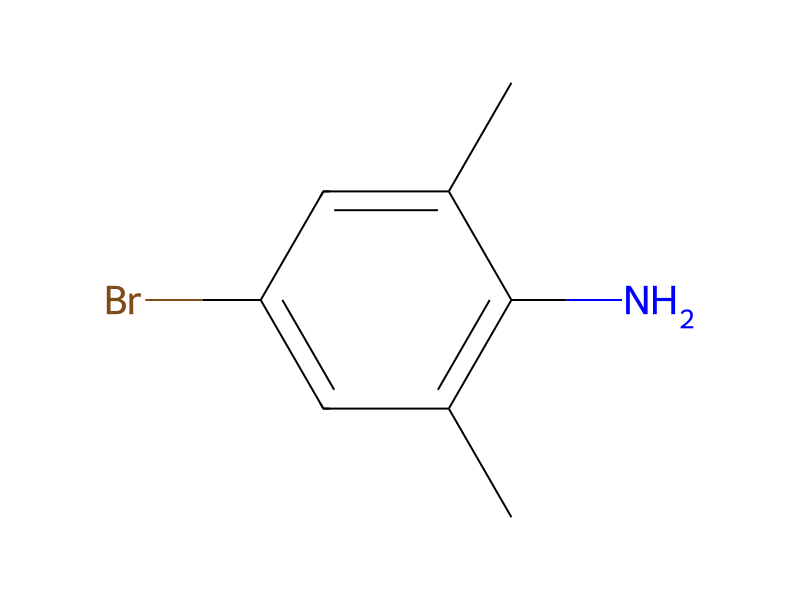
Reactant 2

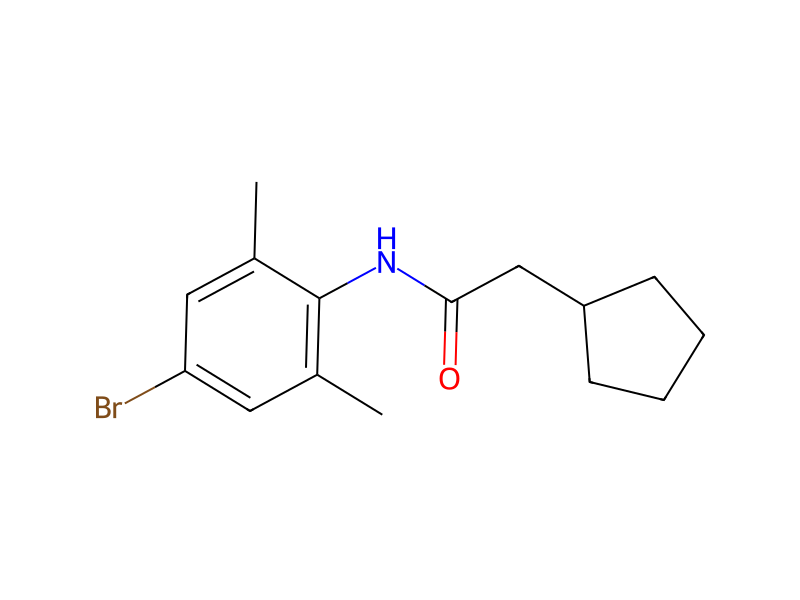
Product 1
Reagents, catalysts & solvents 1

Conditions
- Temperature
- 150 °C
Procedure
4-Bromo-2,6-dimethylaniline (5.92 g) and cyclopentylacetyl chloride (4.87 mL) were dissolved in acetonitrile (26 mL) and heated to 150° C. for 10 minutes in a sealed microwave process vial. The reaction was cooled to 0° C., the product filtered off and washed with cold acetonitrile (50 mL) affording 8.43 g (92% yield) of the title compound as a brown solid. The crude product was used without further purification. LC-MS (m/z) 312 (MH+); tR=3.10, (UV, ELSD) 89%, 99%. 1H NMR (500 MHz, CDCl3): 1.22 (m, 2H), 1.52 (m, 2H), 1.63 (m, 2H), 1.77 (m, 2H), 2.06 (s, 6H), 2.31 (m, 1H), 2.64 (d, 2H), 7.15 (s, 2H), 9.98 (b, 1H).
Workup
- temperatureThe reaction was cooled to 0° C.
- filtrationthe product filtered off
- washwashed with cold acetonitrile (50 mL)
Sources & evidence
- ORD record
- ord-5fcb70df1cfb485f943a7f33cd533dfd
- Source dataset
- uspto-grants-2009_03
- Patent number
- US07501414B2
Linked notes
Loading…