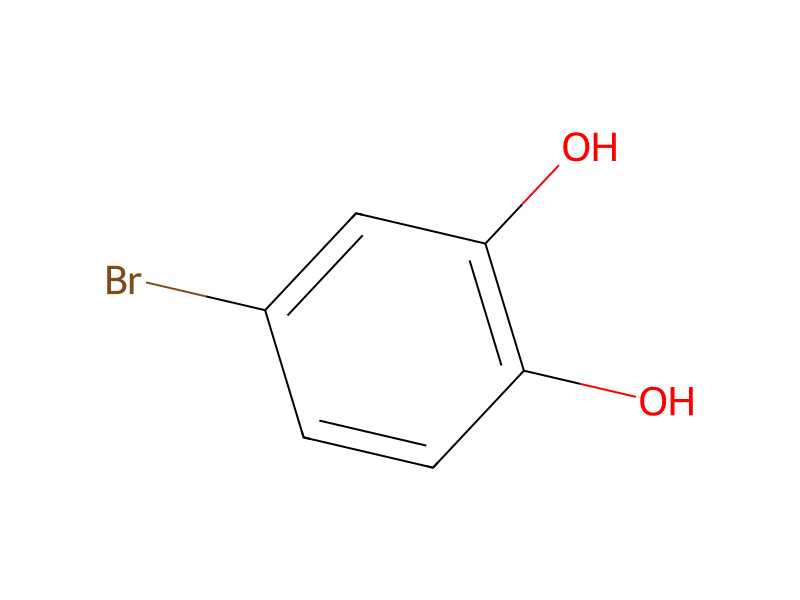
[Br:1][C:2]1[CH:3]=[C:4]([OH:9])[C:5](=[CH:7][CH:8]=1)[OH:6].[O:10]=[C:11]1[C:16](=[O:17])[N:15]([CH2:18][CH3:19])[CH2:14][CH2:13][N:12]1[C:20]([NH:22][CH:23](O)[C:24]([OH:26])=[O:25])=[O:21].C(=O)([O-])[O-].[Na+].[Na+].C(OCC)(=O)C>C(O)(=O)C.S(=O)(=O)(O)O>[O:10]=[C:11]1[C:16](=[O:17])[N:15]([CH2:18][CH3:19])[CH2:14][CH2:13][N:12]1[C:20]([NH:22][CH:23]([C:8]1[CH:7]=[C:5]([OH:6])[C:4]([OH:9])=[CH:3][C:2]=1[Br:1])[C:24]([OH:26])=[O:25])=[O:21]4-Bromocatechol (4.77 g, 25.2 mmole) was added to an ice bath cooled suspension of N-(2,3-dioxo-4-ethylpiperazin-1-yl-carbonyl)-2-hydroxyglycine (2.59 g. 10 mmole) in glacial acetic acid (9 ml) and concentrated sulphuric acid (1 ml). The mixture was stirred for 18 hours then poured onto a mixture of ice, saturated sodium carbonate and ethyl acetate and adjusted to pH7 with sodium carbonate. The aqueous layer was collected, washed with ethyl acetate (50 ml), acidified to pH1 and extracted with ethyl acetate (3×50 ml). The extracts were dried and evaporated in vacuo to a buff solid, 2.4 g, 79%, δ[(CD3)2CO]1.13(3H, t, J7 Hz, CH2CH3), 3.57(2H, q, J7 Hz, CH2CH3), 3.5-4.3(4H, m, 2×NCH2), 5.3-7.6(3H, broad, 2×OH, CO2H), 5.73 (1H, d, J6.5 Hz, CHNH), 6.87 and 7.03 (2H, 2×s, Ar), 9.73(1H, d, J6.5 Hz, CHNH).
Loading…