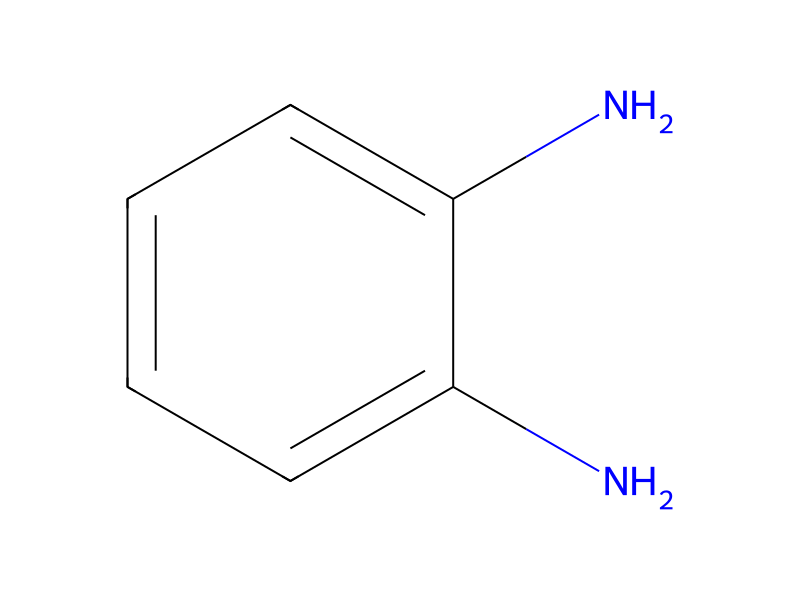
O-Phenylenediamine → 4,4'-(4-(1H-benzo[d]imidazol-2-yl)butane-2,2-diyl)diphenol
HRID 1810726
Reaction equation

[OH:1][C:2]1[CH:7]=[CH:6][C:5]([C:8]([C:15]2[CH:20]=[CH:19][C:18]([OH:21])=[CH:17][CH:16]=2)([CH3:14])[CH2:9][CH2:10][C:11](O)=O)=[CH:4][CH:3]=1.[C:22]1([NH2:29])[CH:27]=[CH:26][CH:25]=[CH:24][C:23]=1[NH2:28]>P(=O)(O)(O)O>[NH:28]1[C:23]2[CH:24]=[CH:25][CH:26]=[CH:27][C:22]=2[N:29]=[C:11]1[CH2:10][CH2:9][C:8]([C:15]1[CH:20]=[CH:19][C:18]([OH:21])=[CH:17][CH:16]=1)([C:5]1[CH:6]=[CH:7][C:2]([OH:1])=[CH:3][CH:4]=1)[CH3:14]Participants
4
Reactant 2

Product 1

Reagents, catalysts & solvents 1

Procedure
In a four neck 250 mL reaction kettle equipped with an overhead stirrer, thermocouple, gas inlets adapter and condenser, were charged 30.01 gram 4,4-bis(4-hydroxyphenyl)pentanoic acid (0.1048 moles), 15.17 gram 1,2-phenylenediamine (0.1403 moles) and 150 gram polyphosphoric acid. The mixture was stirred at 250 rpm at room temperature for 15 minutes and heated up to 120° C. under argon atmosphere. The reaction was continued for 3 hours and the product was cooled to room temperature. The product obtained in phosphoric acid solution was isolated by precipitating in water followed by neutralization and filtration. The isolated product was dried in vacuum at 90° C. for 48 hours. The conversion of acid to benzimidazole functionality was confirmed by IR spectroscopy.