Reaction equation
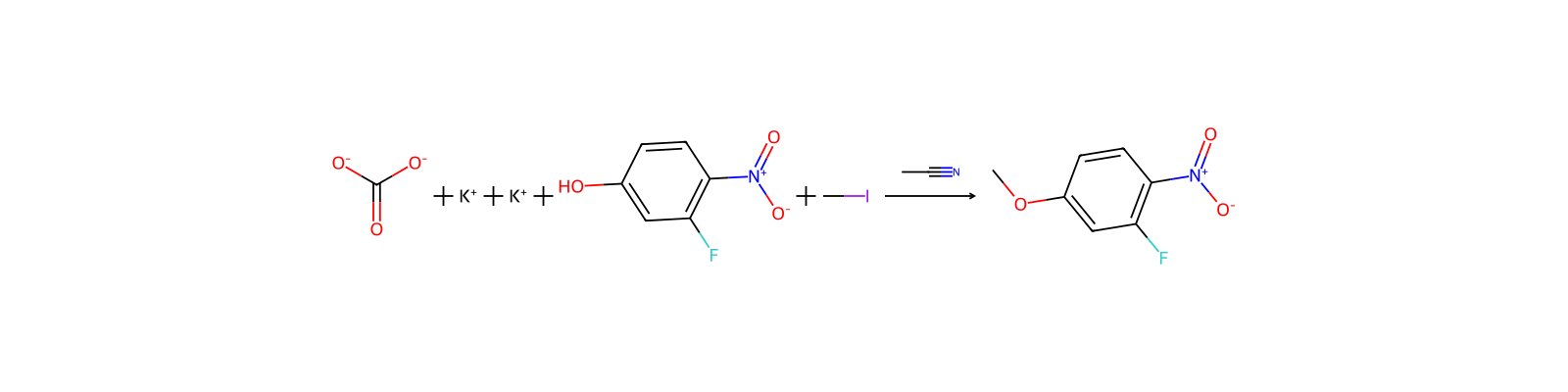
[C:1]([O-])([O-])=O.[K+].[K+].[OH:7][C:8]1[CH:13]=[CH:12][C:11]([N+:14]([O-:16])=[O:15])=[C:10]([F:17])[CH:9]=1.CI>C(#N)C>[CH3:1][O:7][C:8]1[CH:13]=[CH:12][C:11]([N+:14]([O-:16])=[O:15])=[C:10]([F:17])[CH:9]=1Participants
Reactant 3



Product 1

Reagents, catalysts & solvents 1

Procedure
A 2 L round bottom flask equipped with a stir bar and reflux condenser was charged with acetonitrile (1 L), K2CO3 (263 g, 1.9 mol) and 4-hydroxy-2-fluoro-1-nitrobenzene (100 g, 0.64 mol). Methyl iodide (271 g, 1.9 mol) was added to the reaction mixture and heated at reflux temperatures with vigorous stirring for 5 h. The acetonitrile was removed and ethyl acetate (1 L) and H2O (700 mL) were added. The heterogeneous mixture was transferred to a separatory funnel where the aqueous phase was separated and re-extracted with ethyl acetate (2×200 mL). The organic phases were combined and washed with H2O (2×500 mL), brine (500 mL), dried over MgSO4, filtered and concentrated under reduced pressure to give the desired product as a slightly yellow solid (107 g, 98%).
Workup
- customA 2 L round bottom flask equipped with a stir bar
- temperaturereflux condenser
- temperatureheated
- temperatureat reflux temperatures
- customThe acetonitrile was removed
- additionethyl acetate (1 L) and H2O (700 mL) were added
- customThe heterogeneous mixture was transferred to a separatory funnel
- customwhere the aqueous phase was separated
- extractionre-extracted with ethyl acetate (2×200 mL)
- washwashed with H2O (2×500 mL), brine (500 mL)
- dry with materialdried over MgSO4
- filtrationfiltered
- concentrationconcentrated under reduced pressure
Sources & evidence
- ORD record
- ord-9cfd2c4efaa3466e8bf36ec23ed7282b
- Source dataset
- uspto-grants-2010_06
- Patent number
- US07741355B2
Linked notes
Loading…