HomeMCPWorkbenchSkills
HomeWorkbenchNotificationsMe
llms.txt · MCP GuidePrivacy Policy · Terms of Service · Supportv1.8.3
  1. Home
  2. /Reaction

Dicyclohexylcarbodiimide → 1-propyl (2S)-1-(3,3-dimethyl-1,2-dioxopentyl)-2-piperidinecarboxylate

HRID 1858542
Print

Reaction equation

HRID 1858542 reaction equation
[C:1]1(CC[C@H](C2C=CC=C(OCCCC(=O)NOC(C)(C)C)C=2)O)[CH:6]=CC=C[CH:2]=1.[O:29]=[C:30]([N:38]1[CH2:43][CH2:42][CH2:41][CH2:40][C@H:39]1[C:44]([OH:46])=[O:45])[C:31](=[O:37])[C:32]([CH3:36])([CH3:35])[CH2:33][CH3:34].C1(N=C=NC2CCCCC2)CCCCC1>C(Cl)Cl.CN(C)C1C=CN=CC=1>[CH3:36][C:32]([CH3:35])([CH2:33][CH3:34])[C:31](=[O:37])[C:30]([N:38]1[CH2:43][CH2:42][CH2:41][CH2:40][C@H:39]1[C:44]([O:46][CH2:2][CH2:1][CH3:6])=[O:45])=[O:29]
ParticipantsProcedureWorkupSources & evidenceReaction notes

Participants

6

Reactant 3

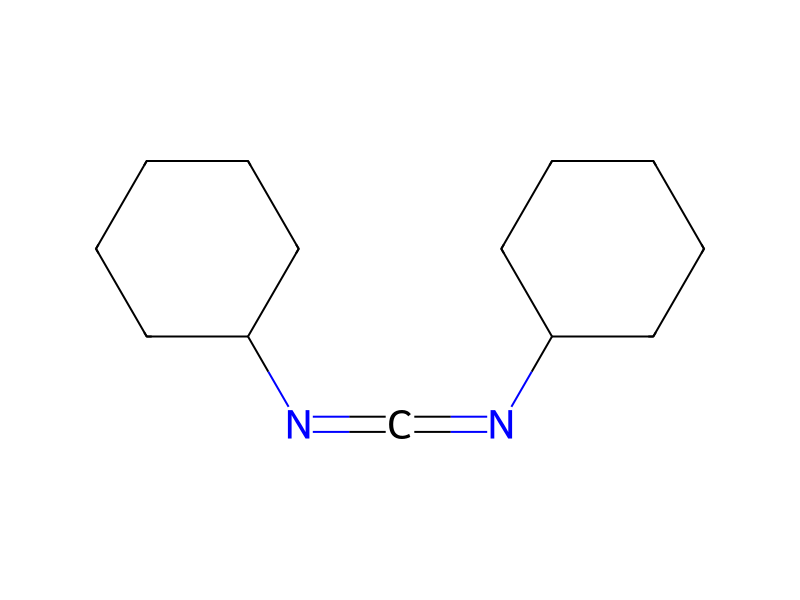
HCID 10868DicyclohexylcarbodiimideHCID 52893282-Piperidinecarboxylic acid, 1-(3,3-dimethyl-1,2-dioxopentyl)-, (2S)-HCID 54443070(1R)-3-Phenyl-1-(3-(3-tert-butyloxycarbamoylpropyl)oxyphenyl)propan-1-ol

Product 1

HCID 865863261-propyl (2S)-1-(3,3-dimethyl-1,2-dioxopentyl)-2-piperidinecarboxylateYield 176.2%

Reagents, catalysts & solvents 2

HCID 14284
4-(Dimethylamino)pyridine
Catalyst
HCID 6344DichloromethaneSolvent

Procedure

A solution of alcohol 2 (385 mg, 1.0 mmol) in CH2Cl2 (3 mL) was treated with (2S)-1-(1,2-dioxo-3,3-dimethylpentyl)-2-piperidinecarboxylic acid (23, 255 mg, 1.0 mmol, prepared from L-pipercolic acid in 4 steps following literature procedures by Holt et al. J. Amer. Chem. Soc., 1993,115, 9925-9938), followed by 1,3-dicyclohexylcarbodiimide (DCC, 247 mg, 1.2 mmol), and 4-(dimethylamino)-pyridine (DMAP, 85 mg, 0.70 mmol) under a nitrogen atmosphere. The resulting bright yellow suspension was allowed to stir overnight. The mixture was then filtered through glass wool and chromatographed (silica gel, 20% EtOAc/hexanes) to give (1R)-3-Phenyl-1-[3-9(3-tert-butyloxycarbamylpropyl)oxy)phenyl]-1-propyl (2S)-1-(3,3-dimethyl-1,2-dioxopentyl)-2-piperidinecarboxylate (524 mg, 84%) as a colorless oil: 1H NMR (CDCl3, 300 MHz) (single diastereomer, mixture of rotamers) 7.35-6.90 (m, 9H), 5.80 (t, J=5.9 Hz, 1H), 5.32 (d, J=5.0 Hz, 0.82 H, pipercolate a-H of rotamer A), 4.80 (br. s, 1H), 4.02 (t, J=6.1 Hz, 2H), 3A0-3.25 (m, 3H), 3.12 (td, J=13.0,3.3 Hz, 1H), 2.60 (m, 2H), 2.35 (d, J=14 Hz, 1H), 2.28 (m, 1H), 2.07 (m, 1H), 1.96 (t, J=6.3 Hz, 2H), 1.80-1.60 (m, 5H), 1.43 (s, 9H), 1.22 (s, 3H), 1.20 (s, 3H), 0.88 (t, J=7.4 Hz, 3H); 13C NMR (CDCl3, 75MHz) (single diastereomer, mixture of rotamers) 208.2, 170.1, 167.6, 159.4, 156.4, 141.7, 141.3, 130.1, 128.9, 128.7, 126.5, 119.4, 114.7, 113.2, 113.0, 66.1, 57.1, 51.7, 47.1, 44.5, 38.3, 32.9, 32.1, 30.0, 28.8, 26.8, 25.4, 24.9, 24.0, 23.8, 23.5, 21.6, 9.1. MS(FAB): (M+Na)+ 645, (M+H)+ 623.

Workup

  1. filtrationThe mixture was then filtered through glass wool
  2. customchromatographed (silica gel, 20% EtOAc/hexanes)

Sources & evidence

ORD record
ord-5bc4f99c424d433db189e56adf11ce9a
Source dataset
uspto-grants-2000_11
DOI
10.6084/m9.figshare.5104873.v1
Patent number
US06150527

Reaction notes

On this pageParticipantsProcedureWorkupSources & evidenceReaction notes

