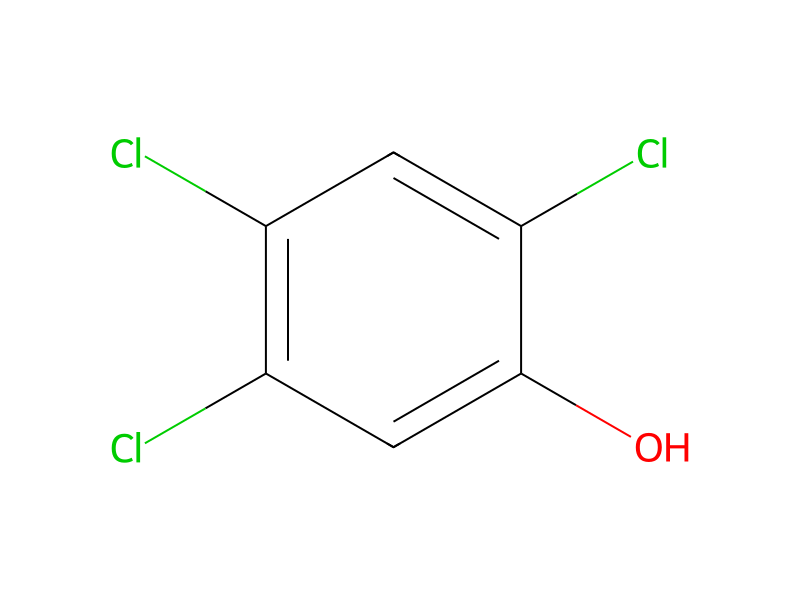
[Cl:1][C:2]1[CH:3]=[C:4]([CH2:9][C:10]([OH:12])=[O:11])[CH:5]=[CH:6][C:7]=1[OH:8].[Cl:13][C:14]1[CH:19]=[C:18]([Cl:20])[C:17]([Cl:21])=[CH:16][C:15]=1O.C1CCC(N=C=NC2CCCCC2)CC1>C(OCC)(=O)C.ClCCl>[Cl:1][C:2]1[CH:3]=[C:4]([CH2:9][C:10]([O:12][C:15]2[CH:16]=[C:17]([Cl:21])[C:18]([Cl:20])=[CH:19][C:14]=2[Cl:13])=[O:11])[CH:5]=[CH:6][C:7]=1[OH:8]A solution of 4 g (21.6 mmol) of 3-chloro-4-hydroxyphenylacetic acid in 130 mL of ethyl acetate is slowly added to a solution of 4.7 g (23.6 mmol) of 2,4,5-trichlorophenol and 4.9 g (23.6 mmol) of DCC in 22 mL of dichloromethane and the reaction mixture is stirred overnight. The precipitate formed is separated by filtration and the solution is chilled to precipitate the rest of N,N-dicyclohexylurea. After a second filtration, the filtrate is washed three times with a solution of sodium bicarbonate, dried over MgSO4 and evaporated to dryness in a rotary evaporator. The resulting oil is chromatographed through silica gel eluting with hexanes and increasing amounts of dichloromethane. The desired product appears in the fraction eluted with 50% dichloromethane. After elimination of the solvent 2.8 g of product are isolated (34% yield), with the following analytical data: mp=77° C. Rf=0.33 (AcOEt/hexanes 3:7).