Reaction equation

[CH2:1]([C:4]([P:10]([O-:13])([OH:12])=[O:11])([P:6]([O-:9])([OH:8])=[O:7])[OH:5])[CH2:2][NH2:3].[Na+:14].[Na+].C(C(P(O)(O)=O)(P(O)(O)=O)[OH:20])CN.[OH-].[Na+]>O>[CH2:1]([C:4]([P:10]([O-:13])([OH:12])=[O:11])([P:6]([O-:8])([OH:9])=[O:7])[OH:5])[CH2:2][NH2:3].[OH2:20].[Na+:14].[Na+:14]Participants
Reactant 3
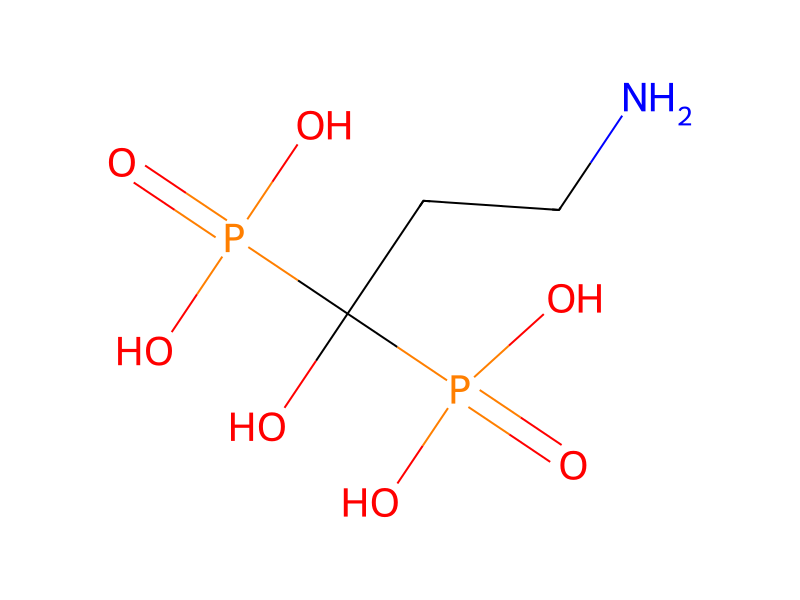


Product 1

Reagents, catalysts & solvents 1

Procedure
In the process for preparing crystalline disodium pamidronate from the reaction solution for neutralization of pamidronic acid with sodium hydroxide according to the first method, it is characterized to be included the process which pamidronic acid is neutralized with sodium hydroxide at about 90° C. in the range of pH 7.5˜8.5: the insoluble materials produced after neutralization is filtered: an alcohol is added to the filtrate to produce a salt: the resulting salt is dissolved in water and is allowed to stand at room temperature to induce crystallization: the resulting crystallizing solution is cooled to obtain the crystals: and then the resulting crystals are dried at the temperature of 75˜85° C. under normal pressure to obtain the crystalline disodium pamidronate hydrate.
Workup
- customthe insoluble materials produced after neutralization
- filtrationis filtered
- additionan alcohol is added to the filtrate
- customto produce a salt
- customto stand at room temperature
- customcrystallization
- customthe resulting crystallizing solution
- temperatureis cooled
- customto obtain the crystals
- customthe resulting crystals are dried at the temperature of 75˜85° C. under normal pressure
Sources & evidence
- ORD record
- ord-eb517ef6275e4eaeb46cc2131a17235e
- Source dataset
- uspto-grants-2003_03
- Patent number
- US06534674B2
Linked notes
Loading…