
Pamidronic Acid
Completing data — refresh the page later to see the latest
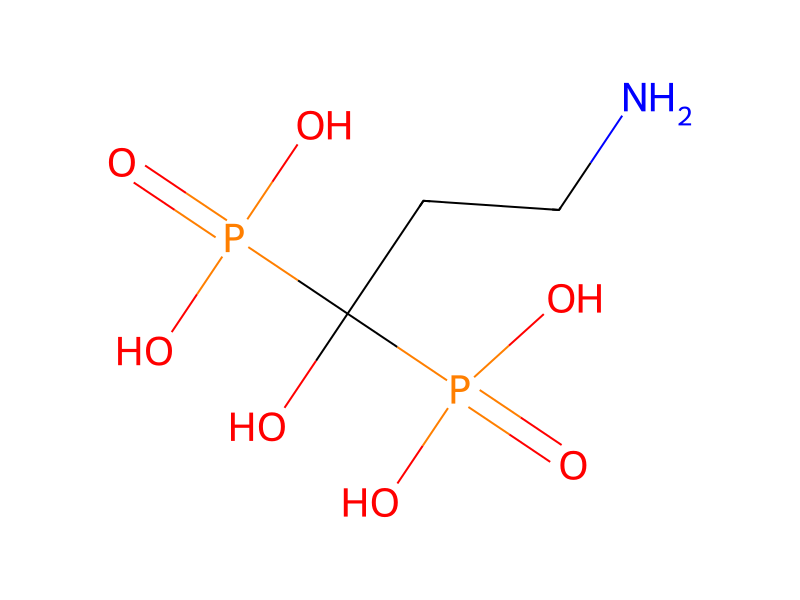
Basic information
- CAS
40391-99-9- Standard SMILES
NCCC(O)(P(=O)(O)O)P(=O)(O)O- InChIKey
WRUUGTRCQOWXEG-UHFFFAOYSA-N- Molecular formula
- C3H11NO7P2
- Average molar mass
- 235.07 g/mol
- Monoisotopic mass
- 235.00107495
Overview
Pamidronate is a phosphonoacetic acid.
Names & identifiers
- Preferred name
- Pamidronic Acid
- IUPAC
- (3-amino-1-hydroxy-1-phosphonopropyl)phosphonic acid
- English name
- Pamidronic acid
- Molecular formula
- C3H11NO7P2
- Molecular weight
- 235.07
Names & synonyms
PAMIDRONIC ACIDpamidronate40391-99-9AmidronateAcide pamidronique(3-amino-1-hydroxy-1-phosphonopropyl)phosphonic acidAcido pamidronicoAcidum pamidronicumRibodroat(3-Amino-1-hydroxypropylidene)bisphosphonic acidDTXSID4023414AHPrBP
Show more names
(3-Amino-1-hydroxypropane-1,1-diyl)bis(phosphonic acid)DLVPanolinRescriptorPamidronicaciIflab-bb F1977-0047Delavirdine mesylate
OYY3447OMC(3-Amino-1-hydroxypropylidene)diphosphonic acidDTXCID003414(3-amino-1-hydroxypropylidene)-1,1-biphosphonateaminopropanehydroxydiphosphonateamino-1-hydroxypropane-1,1-diphosphonateRefChem:57113M05BA03
Database identifiers
- CAS
40391-99-9- PubChem CID
- 4674
- DTXSID
DTXSID4023414- ChEMBL
CHEMBL834- ChEBI
CHEBI:7903- UNII
- OYY3447OMC
- EC Number
- 254-905-2
- Nikkaji
- J221.669H
Properties
Computed structural propertiesFilling in
- XLogP
- -6.9
- Topological polar surface area
- 161 Ų
- Hydrogen bond donors
- 6
- Hydrogen bond acceptors
- 8
- Rotatable bonds
- 4
- Heavy atoms
- 13
- Formal charge
- 0
- Complexity
- 243
Experimental & physicochemical properties
Drugs
Pharmaceuticals
Pharmaceuticals -> Listed in ZINC15
LogP-4.7
Solubility1.58e+01 g/L
Human DrugsBreast Feeding; Lactation; Milk, Human; Bisphosphonates; Bone Density Conservation Agents; Diphosphonates
Melting Point254-262
Physical DescriptionSolid
Physicochemical properties
- Melting point
- 226 · 226-228°C
- Boiling point
- 658.7 · 658.7±65.0 °C(Predicted)
- Density
- 1.998 · 1.998±0.06 g/cm3(Predicted)
- storage temp.
- 2 · under inert gas (nitrogen or Argon) at 2–8 °C
- solubility
- Methanol (Very Slightly, Heated, Sonicated), Water (Slightly, Heated, Sonicated)
- pka
- 1.44 · 1.44±0.10(Predicted)
- form
- Solid
- color
- Light Brown to Beige
- Stability
- Hygroscopic
- InChI
- InChI=1S/C3H11NO7P2/c4-2-1-3(5,12(6,7)8)13(9,10)11/h5H,1-2,4H2,(H2,6,7,8)(H2,9,10,11)
- InChIKey
- WRUUGTRCQOWXEG-UHFFFAOYSA-N
- SMILES
- C(P(=O)(O)O)(P(=O)(O)O)(O)CCN
- FDA UNII
- 3447 OMC · OYY3447OMC
- ATC code
- 5 BA03 · M05BA03
- Symbol(GHS)
- 7 · GHS07
- Signal word
- Warning
- Hazard statements
- 302 · H302
- Precautionary statements
- 264 · P264-P270-P301+P312-P330-P501
- HS Code
- 9999999999 · 9999999999
Safety & regulation
Safety information is for reference only and does not replace the supplier’s Safety Data Sheet (SDS), applicable regulations, or professional assessment.
GHS classification
GHS Classification
Warning
H302 (100%): Harmful if swallowed [Warning Acute toxicity, oral]
P264, P270, P301+P317, P330, and P501 (click each P-code to see the statement)
Aggregated GHS information provided per 24 reports by companies from 4 notifications to the ECHA C&L Inventory.
Hazard information
Hazard Classes and CategoriesAcute Tox. 4 (100%)
Toxicology
TreatmentIf overdosage occurs, symptomatic hypocalcemia could also result; such patients should be treated with short-term intravenous calcium. (L1712)
Health EffectsRare cases of uveitis, iritis, scleritis, and episcleritis have been reported, including one case of scleritis, and one case of uveitis upon separate rechallenges.
Adverse EffectsPamidronate correlates with numerous adverse effects, including hypocalcemia and resulting secondary hyperparathyroidism, acute phase response, musculoskeletal pain, various ocular events, and osteonecrosis of the jaw.
Exposure RoutesParenteral (intravenous).
Plasma concentration rises rapidly upon IV administration.
Toxicity Summary
A small number of cases describe symptomatic hypocalcemia following pamidronate administration. In each case, however, patients had pre-existing derangements contributing to their symptoms, including renal insufficiency and low vitamin D levels secondary to lifestyle, previous GI surgery, and medication history. Recommendations for the management of pamidronate overdose include appropriate correction of the electrolyte disturbance and pre-treatment supplementation with calcium and Vitamin D.
The mechanism of action of pamidronate is inhibition of bone resorption. Pamidronate adsorbs to calcium phosphate (hydroxyapatite) crystals in bone and may directly block dissolution of this mineral component of bone. In vitro studies also suggest that inhibition of osteoclast activity contributes to inhibition of bone resorption. Pamidronate also targets farnesyl pyrophosphate (FPP) synthase. Nitrogen-containing bisphosphonates (such as pamidronate, alendronate, risedronate, ibandronate and zoledronate) appear to act as analogues of isoprenoid diphosphate lipids, thereby inhibiting FPP synthase, an enzyme in the mevalonate pathway. Inhibition of this enzyme in osteoclasts prevents the biosynthesis of isoprenoid lipids (FPP and GGPP) that are essential for the post-translational farnesylation and geranylgeranylation of small GTPase signalling proteins. This activity inhibits osteoclast activity and reduces bone resorption and turnover. In postmenopausal women, it reduces the elevated rate of bone turnover, leading to, on average, a net gain in bone mass.
Signs and SymptomsSide effects include an allergic reaction, kidney problems, seizures, low levels of calcium, magnesium, or phosphorus in the blood
Carcinogen ClassificationNo indication of carcinogenicity to humans (not listed by IARC).
Drug Induced Liver Injury
Drug-Induced Liver Injury Severity and Toxicity (DILIst)
pamidronate
DILI Negative
Intravenous
DOI:10.1016/j.drudis.2019.09.022
Effects During Pregnancy and Lactation◉ Summary of Use during Lactation
Safety data
- hs_code
- 9999999999
- Signal word
- Warning
- Symbol(GHS)
- GHS07
- Hazard statements
- H302
- Precautionary statements
- P264-P270-P301+P312-P330-P501
Chemistry & industry
Pharmacology
ATC Code
M05BA03
M - Musculo-skeletal system
QM - Musculo-skeletal system
Protein BindingPamidronate is approximately 54% protein bound in serum.
Pharmacodynamics
Pamidronic acid is a second generation, nitrogen containing bisphosphonate that inhibits osteoclast mediated bone loss It has a wide therapeutic index and a long duration of action as it can be given every 3-4 weeks for certain indications. Patients should be counselled regarding the risk of elevated blood urea nitrogen, renal tubular necrosis, and nephrotoxicity.
Mechanism of Action
Bisphosphonates are taken into the bone where they bind to hydroxyapatite. Bone resorption by osteoclasts causes local acidification, releasing the bisphosphonate, which is taken into the osteoclast by fluid-phase endocytosis. Endocytic vesicles become acidified, releasing bisphosphonates into the cytosol of osteoclasts where they act. Osteoclasts mediate resorption of bone. When osteoclasts bind to bone they form podosomes, ring structures of F-actin. Disruption of the podosomes causes osteoclasts to detach from bones, preventing bone resorption. Nitrogen containing bisphosphonates such as pamidronate are known to induce apoptosis of hematopoietic tumor cells by inhibiting the components of the mevalonate pathway farnesyl diphosphate synthase, farnesyl diphosphate, and geranylgeranyl diphosphate. These components are essential for post-translational prenylation of GTP-binding proteins like Rap1. The lack of prenylation of these proteins interferes with their function, and in the case of Rap1, leads to apoptosis. pamidronate also activated caspases 3 and 9 which further contribute to apoptosis.
Biological Half-LifeThe mean elimination half life of pamidronate is 28±7 hours.
Metabolism/Metabolites
Pamidronate is not metabolized _in vivo_.
Pamidronate is not metabolized and is exclusively eliminated by renal excretion. Route of Elimination: Pamidronate is not metabolized and is exclusively eliminated by renal excretion. Half Life: The mean ± SD elimination half-life is 28 ± 7 hours
FDA Pharmacological Classification
OYY3447OMC
PAMIDRONIC ACID
Established Pharmacologic Class [EPC] - Bisphosphonate
Chemical Structure [CS] - Diphosphonates
Pamidronic acid is a Bisphosphonate.
MeSH Pharmacological ClassificationAgents that inhibit BONE RESORPTION and/or favor BONE MINERALIZATION and BONE REGENERATION. They are used to heal BONE FRACTURES and to treat METABOLIC BONE DISEASES such as OSTEOPOROSIS.
Absorption, Distribution and Excretion
In patients with a creatinine clearance >90mL/min, a 90mg intravenous dose reached a Cmax of 1.92±1.08µg/mL, with a Tmax of 4h, and an AUC of 10.2±6.95µg\*h/mL. In patients with a creatinine clearance 61-90mL/min, a 90mg intravenous dose reached a Cmax of 1.86±0.50µg/mL, with a Tmax of 4h, and an AUC of 10.7—3.91µg\*h/mL.[A203264 In patients with a creatinine clearance 30-60mL/min, a 90mg intravenous dose reached a Cmax of 1.84±0.58µg/mL, with a Tmax of 4h, and an AUC of 10.1±3.38µg\*h/mL. In patients with a creatinine clearance <30mL/min, a 90mg intravenous dose reached a Cmax of 1.93±0.53µg/mL, with a Tmax of 4h, and an AUC of 34.0±8.37µg\*h/mL.
Pamidronate is exclusively eliminated in the urine. By 120 hours after administration, 46±16% of the dose has been eliminated in the urine.
The mean total clearance of pamidronate is 107±50mL/min and the mean renal clearance is 49±28mL/min.
Cellular LocationsCytoplasm
Metabolite PathwaysPamidronate Action Pathway
Uses & manufacturing
Uses
Use (kg; approx.) in Germany (2009): >10
Pamidronate is in a class of drugs called bisphosphonates. Pamidronate reduces breakdown of the bones. Pamidronate is used in the treatment of Paget's disease of bone; to reduce high levels of calcium in the blood associated with malignancy (cancer); and to reduce the breakdown of bone due to metastases of breast cancer or multiple myeloma. For the treatment of moderate or severe hypercalcemia associated with malignancy
Applications
UsesA biphosphonate bone resorption inhibitor.
Usesanticancer
Upstream & downstream products
Upstream raw materials
Additional notes
DefinitionChEBI: Pamidronate is a phosphonoacetic acid.
Related reactions
21 records


Compound notes
Loading…