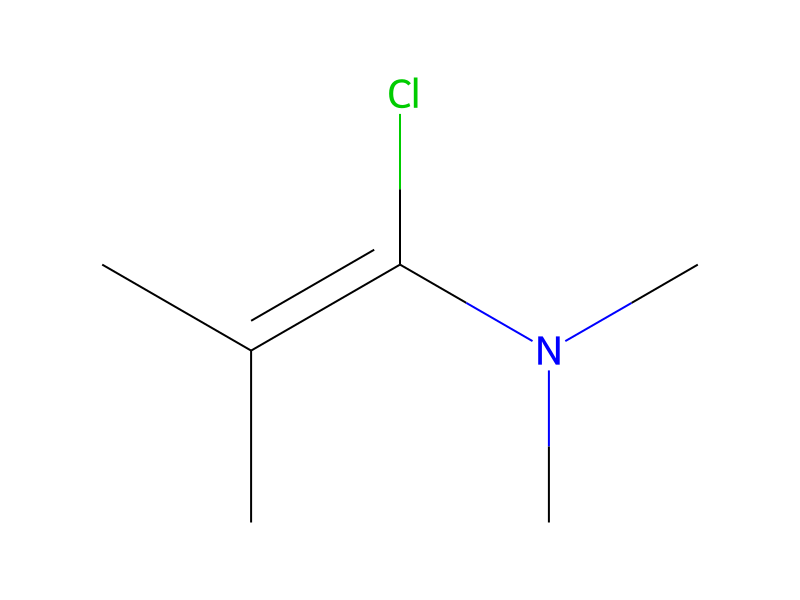
[Cl:1][C:2]1[CH:7]=[CH:6][C:5]([C:8]2[N:13]=[C:12]([C:14]([OH:16])=O)[CH:11]=[N:10][C:9]=2[O:17][CH2:18][CH2:19][O:20][CH3:21])=[CH:4][CH:3]=1.ClC(N(C)C)=C(C)C.Cl.[NH2:31][C:32]1([CH2:35][OH:36])[CH2:34][CH2:33]1.C(N(C(C)C)C(C)C)C>ClCCl>[OH:36][CH2:35][C:32]1([NH:31][C:14]([C:12]2[CH:11]=[N:10][C:9]([O:17][CH2:18][CH2:19][O:20][CH3:21])=[C:8]([C:5]3[CH:4]=[CH:3][C:2]([Cl:1])=[CH:7][CH:6]=3)[N:13]=2)=[O:16])[CH2:34][CH2:33]1To a suspension of 0.05 g (0.00016 mol) of 6-(4-chloro-phenyl)-5-(2-methoxy-ethoxy)-pyrazine-2-carboxylic acid in 2.0 ml dichloromethane was added 0.024 g 1-chloro-N,N,2-trimethyl-1-propenylamine and the mixture was stirred at room temperature for 30 min. To the resulting slightly brown solution was added 0.040 g of (1-amino-cyclopropyl)-methanol hydrochloride and dropwise 0.1 ml N-ethyldiisopropyl-amine. The mixture was stirred at ambient temperature for 30 min. The resulting mixture was partitioned between 10% aqueous citric acid and ethyl acetate. The phases were separated and the organic phase was dried over magnesium sulfate and evaporated. The residue was purified by chromatography on silica gel using a gradient of heptane to ethyl acetate to yield 0.035 g (55% yield) of the title compound as off white solid. MS (ISP) (M+H+)=378.3.