Reaction equation

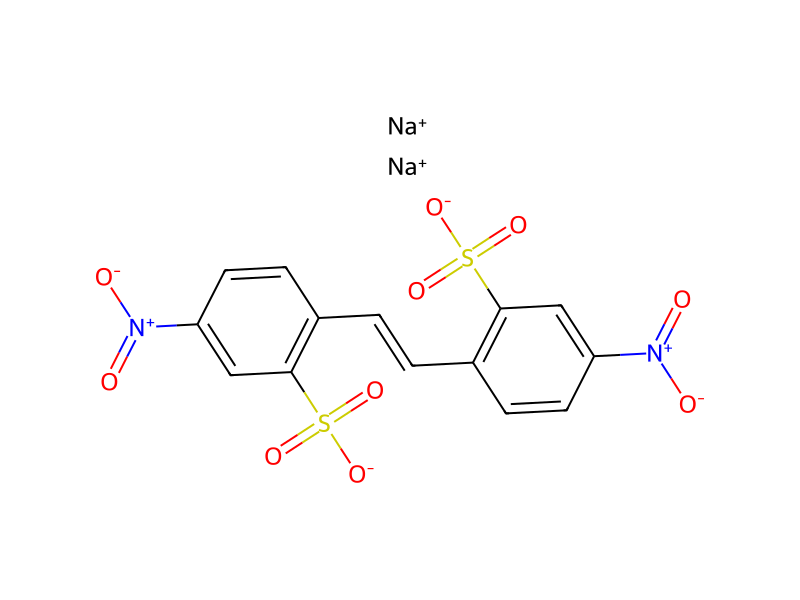
[N+:1]([C:4]1[CH:5]=[C:6]([S:25]([O-:28])(=[O:27])=[O:26])[C:7]([CH:10]=[CH:11][C:12]2[C:13]([S:21]([O-:24])(=[O:23])=[O:22])=[CH:14][C:15]([N+:18]([O-])=O)=[CH:16][CH:17]=2)=[CH:8][CH:9]=1)([O-])=O.[Na+:29].[Na+].OS(O)(=O)=O>[Pt].O>[NH2:1][C:4]1[CH:5]=[C:6]([S:25]([O-:28])(=[O:27])=[O:26])[C:7]([CH:10]=[CH:11][C:12]2[C:13]([S:21]([O-:24])(=[O:23])=[O:22])=[CH:14][C:15]([NH2:18])=[CH:16][CH:17]=2)=[CH:8][CH:9]=1.[Na+:29].[Na+:29]Participants
5
Reactant 2

Product 1

Reagents, catalysts & solvents 2


Procedure
A 300 ml steel autoclave is charged with 48 g of sodium 4,4'-dinitrostilbene-2,2'-disulfonate, 174 g of water, 0.15 ml of 0.5 M H2SO4, 1.4 g of activated carbon, 64 mg of 5% Pt/C and 12 mg of NH4VO3. The autoclave is closed and flushed with nitrogen. The hydrogenation is carried out at 70° C. with the controlled addition of hydrogen of 2.5 NI/h (max. 4-5 bar hydrogen). After the hydrogenation is terminated, the autoclave is rendered inert, the catalyst is filtered off and the reaction mixture is analysed with HPLC. The results are listed in Table 3.
Workup
- customThe autoclave is closed
- customflushed with nitrogen
- additionThe hydrogenation is carried out at 70° C. with the controlled addition of hydrogen of 2.5 NI/h (max. 4-5 bar hydrogen)
- customAfter the hydrogenation is terminated
- filtrationthe catalyst is filtered off
Sources & evidence
- ORD record
- ord-d5a6cd6fc00847c1ad73d9cb85e52aab
- Source dataset
- uspto-grants-2000_08
- Patent number
- US06096924
Linked notes
Loading…