Reaction equation

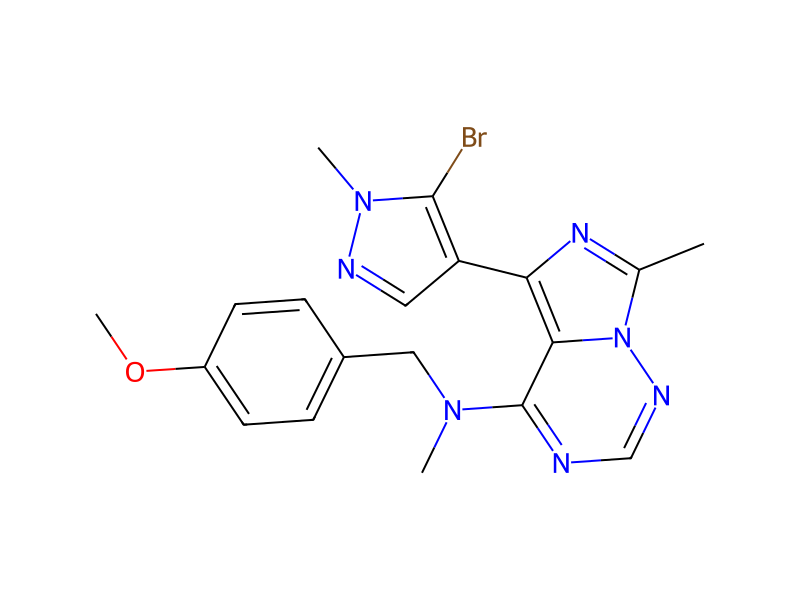
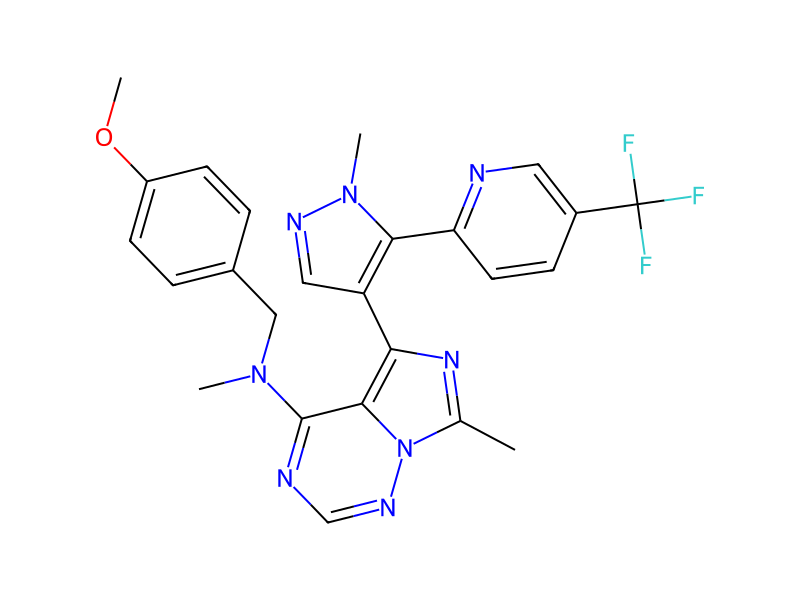
Br[C:2]1[N:6]([CH3:7])[N:5]=[CH:4][C:3]=1[C:8]1[N:9]=[C:10]([CH3:28])[N:11]2[C:16]=1[C:15]([N:17]([CH2:19][C:20]1[CH:25]=[CH:24][C:23]([O:26][CH3:27])=[CH:22][CH:21]=1)[CH3:18])=[N:14][CH:13]=[N:12]2.C([Li])CCCCC.Br[C:37]1[CH:42]=[CH:41][C:40]([C:43]([F:46])([F:45])[F:44])=[CH:39][N:38]=1>O1CCCC1.[Cl-].[Zn+2].[Cl-].C1C=CC([P]([Pd]([P](C2C=CC=CC=2)(C2C=CC=CC=2)C2C=CC=CC=2)([P](C2C=CC=CC=2)(C2C=CC=CC=2)C2C=CC=CC=2)[P](C2C=CC=CC=2)(C2C=CC=CC=2)C2C=CC=CC=2)(C2C=CC=CC=2)C2C=CC=CC=2)=CC=1>[CH3:27][O:26][C:23]1[CH:24]=[CH:25][C:20]([CH2:19][N:17]([CH3:18])[C:15]2[C:16]3=[C:8]([C:3]4[CH:4]=[N:5][N:6]([CH3:7])[C:2]=4[C:37]4[CH:42]=[CH:41][C:40]([C:43]([F:46])([F:45])[F:44])=[CH:39][N:38]=4)[N:9]=[C:10]([CH3:28])[N:11]3[N:12]=[CH:13][N:14]=2)=[CH:21][CH:22]=1Participants
Reactant 3


Product 1
Reagents, catalysts & solvents 3



Procedure
A solution of 5-(5-bromo-1-methyl-1H-pyrazol-4-yl)-N-(4-methoxybenzyl)-N,7-dimethylimidazo[5,1-f][1,2,4]triazin-4-amine (3.35 g, 7.57 mmol) in tetrahydrofuran (75 mL) was cooled to −78° C. and treated over 5 minutes with n-hexyllithium (2.3 M solution in hexane, 3.46 mL, 7.96 mmol). The reaction mixture was stirred for 30 minutes, and then treated in one portion with a −78° C. solution of zinc chloride (99.5%, 1.30 g, 9.49 mmol) in tetrahydrofuran (20 mL). After stirring for 5 minutes at −78° C., the reaction was warmed to room temperature over 30 minutes. After addition of 2-bromo-5-(trifluoromethyl)pyridine (2.57 g, 11.4 mmol), the reaction mixture was heated to 50° C., treated with tetrakis(triphenylphosphine)palladium(0) (99.9%, 87.9 mg, 0.076 mmol), and maintained at reflux for 4 hours. The reaction was cooled and concentrated in vacuo; the residue was dissolved in ethyl acetate and washed sequentially with water, saturated aqueous ammonium chloride solution, and saturated aqueous sodium bicarbonate solution. After drying over magnesium sulfate, the product solution was filtered and concentrated in vacuo. Purification via silica gel chromatography (Gradient: 0% to 100% ethyl acetate in heptane) provided a pale yellow oil (2.3 g), which was crystallized from heptane to afford the product as a white powder. Yield: 1.58 g, 3.11 mmol, 41%. APCI m/z 509.5 (M+1). 1H NMR (400 MHz, CDCl3) δ 2.54 (s, 3H), 2.72 (s, 3H), 3.76 (s, 3H), 4.14 (s, 3H), 4.34 (br s, 2H), 6.76 (br d, J=8.8 Hz, 2H), 6.94 (br d, J=8.5 Hz, 2H), 7.39 (d, J=8.3 Hz, 1H), 7.72 (s, 1H), 7.76 (dd, J=8.4, 2.2 Hz, 1H), 7.85 (s, 1H), 8.94-8.96 (m, 1H).
Workup
- stirringAfter stirring for 5 minutes at −78° C.
- temperaturethe reaction mixture was heated to 50° C.
- temperaturemaintained
- temperatureat reflux for 4 hours
- temperatureThe reaction was cooled
- concentrationconcentrated in vacuo
- dissolutionthe residue was dissolved in ethyl acetate
- washwashed sequentially with water, saturated aqueous ammonium chloride solution, and saturated aqueous sodium bicarbonate solution
- dry with materialAfter drying over magnesium sulfate
- filtrationthe product solution was filtered
- concentrationconcentrated in vacuo
- customPurification via silica gel chromatography (Gradient: 0% to 100% ethyl acetate in heptane)
Sources & evidence
- ORD record
- ord-179d2b97de3240ec868129a76326e8e5
- Source dataset
- uspto-grants-2013_12
- Patent number
- US08598155B2
Linked notes
Loading…