1,1,1,3,3,3-Hexafluoropropane → Hydrofluoric Acid
Reaction equation
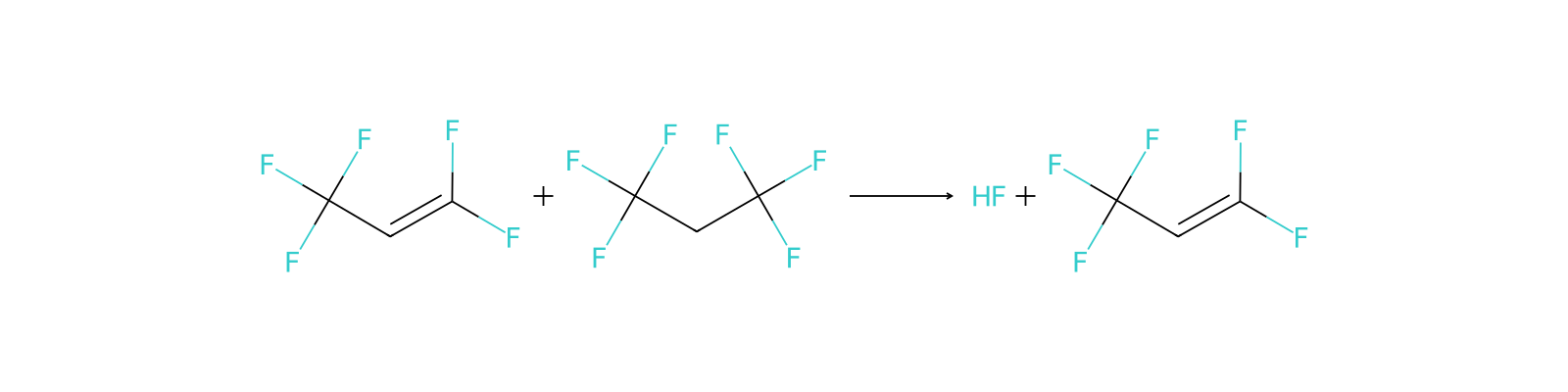
C(C=C(F)F)(F)(F)[F:2].[C:9]([CH2:13][C:14](F)([F:16])[F:15])([F:12])([F:11])[F:10]>>[FH:2].[C:9]([CH:13]=[C:14]([F:16])[F:15])([F:12])([F:11])[F:10]Participants
4


Procedure
The present process produces a 1:1 molar mixture of HF and CF3CH═CF2 in the reactor exit stream. The reactor exit stream can also contain unconverted reactant, CF3CH2CF3. The components of the reactor exit stream can be separated by conventional means, such as distillation. Hydrogen fluoride and CF3CH═CF2 form a homogenous low-boiling azeotrope containing about 60 mole percent CF3CH═CF2. The present process reactor exit stream can be distilled and the low-boiling HF and CF3CH═CF2 azeotrope taken off as a distillation column overhead stream, leaving substantially pure CF3CH2CF3 as a distillation column bottom stream. Recovered CF3CH2CF3 reactant may be recycled to the reactor. CF3CH═CF2 can be separated from its azeotrope with HF by conventional procedures, such as pressure swing distillation or by neutralization of the HF with caustic.