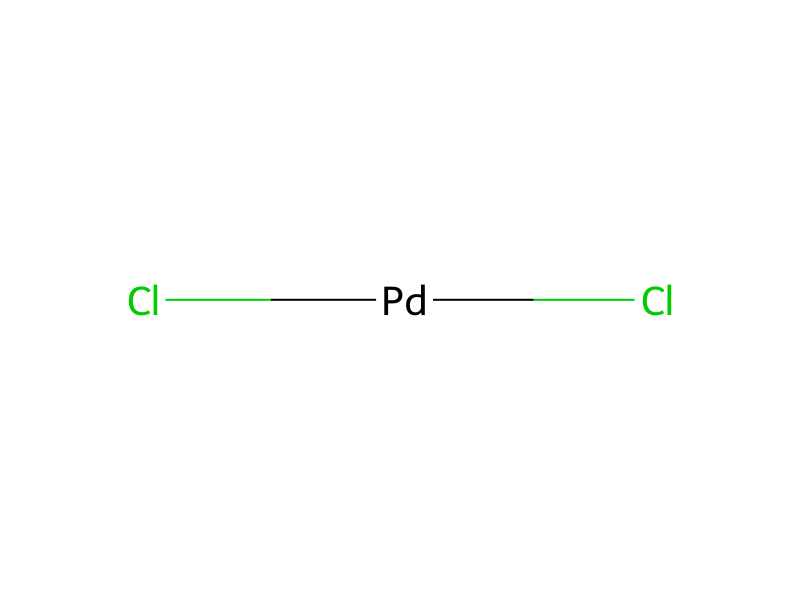
[NH2:1][C:2]1[CH:7]=[C:6]([F:8])[C:5]([N+:9]([O-:11])=[O:10])=[CH:4][C:3]=1[C:12]#[C:13][C:14]([CH3:22])([CH3:21])[CH2:15][C:16]([O:18][CH2:19][CH3:20])=[O:17].C(OCC)(=O)C>CC#N.Cl[Pd]Cl>[F:8][C:6]1[CH:7]=[C:2]2[C:3]([CH:12]=[C:13]([C:14]([CH3:21])([CH3:22])[CH2:15][C:16]([O:18][CH2:19][CH3:20])=[O:17])[NH:1]2)=[CH:4][C:5]=1[N+:9]([O-:11])=[O:10]To a mixture of ethyl 5-(2-amino-4-fluoro-5-nitrophenyl)-3,3-dimethylpent-4-ynoate (34.5 g, 0.11 mol) and PdCl2(10.4 g, 58.6 nmol) in CH3CN (350 mL) was heated to reflux for 1.5 hours. The reaction mixture was cooled down to room temperature. Ethyl acetate (300 mL) was added, the precipitate was filtered off and washed with methanol. The filtrate was concentrated under reduced pressure and the residue was purified by column chromatography on silica gel (petroleum ether/ethyl acetate 40:1) to give ethyl 3-(6-fluoro-5-nitro-1H-indol-2-yl)-3-methylbutanoate (34.0 g, 98%) as a deep yellow solid. 1H NMR (300 MHz, CDCl3) δ 10.11 (brs, 1 H), 8.30 (d, J=7.2 Hz, 1 H), 7.14 (d, J=11.7 Hz, 1 H), 6.35 (d, J=1.5 Hz, 1 H), 4.17 (q, J=7.2 Hz, 2 H), 2.69 (s, 2 H), 1.51 (s, 6 H), 1.25 (t, J=7.2 Hz, 3 H).