Iodine → Tris(4-chlorophenyl)phosphine
Reaction equation

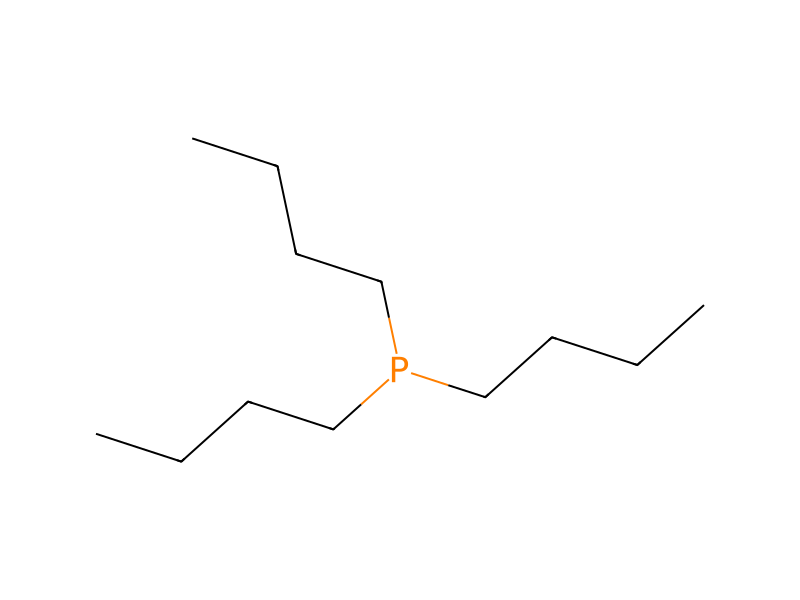
[Cl:1][C:2]1[CH:7]=[CH:6][C:5]([P:8](=O)([C:16]2[CH:21]=[CH:20][C:19]([Cl:22])=[CH:18][CH:17]=2)[C:9]2[CH:14]=[CH:13][C:12]([Cl:15])=[CH:11][CH:10]=2)=[CH:4][CH:3]=1.II.C(P(CCCC)CCCC)CCC>C(#N)C.C1COCC1>[Cl:1][C:2]1[CH:7]=[CH:6][C:5]([P:8]([C:16]2[CH:21]=[CH:20][C:19]([Cl:22])=[CH:18][CH:17]=2)[C:9]2[CH:14]=[CH:13][C:12]([Cl:15])=[CH:11][CH:10]=2)=[CH:4][CH:3]=1Participants
5
Reactant 3


Product 1

Reagents, catalysts & solvents 1

Procedure
100 mg (0.262 mmol) of tris(4-chlorophenyl)phosphineoxide were treated with 6 mg I2 (26 μmol) and tributylphosphine 130 μL (0.52 mmol) in acetonitrile/THF (1:1 v/v) 1 mL. The mixture was stirred at room temperature for 10 minutes under nitrogen atmosphere before it was quenched with H2O (100 μL). The reaction mixture was diluted with ethyl acetate (10 mL) and was washed with portions of sat. NaHCO3 (3×5 mL). The organic fraction was dried with Na2SO4, filtered and the solvent evaporated under vacuum. The resulting residue was recrystallized from methanol (2 mL), the resulting crystals were filtered, washed and dried in vacuum, giving 95 mg (0.260 mmol, 99%) of tris(4-chlorophenyl)phosphine.
Workup
- customwas quenched with H2O (100 μL)
- additionThe reaction mixture was diluted with ethyl acetate (10 mL)
- washwas washed with portions of sat. NaHCO3 (3×5 mL)
- dry with materialThe organic fraction was dried with Na2SO4
- filtrationfiltered
- customthe solvent evaporated under vacuum
- customThe resulting residue was recrystallized from methanol (2 mL)
- filtrationthe resulting crystals were filtered
- washwashed
- customdried in vacuum
Sources & evidence
- ORD record
- ord-00a605984e804a1ab587252b68759a2c
- Source dataset
- uspto-grants-2013_04
- Patent number
- US08426647B2
Reaction notes
Loading…