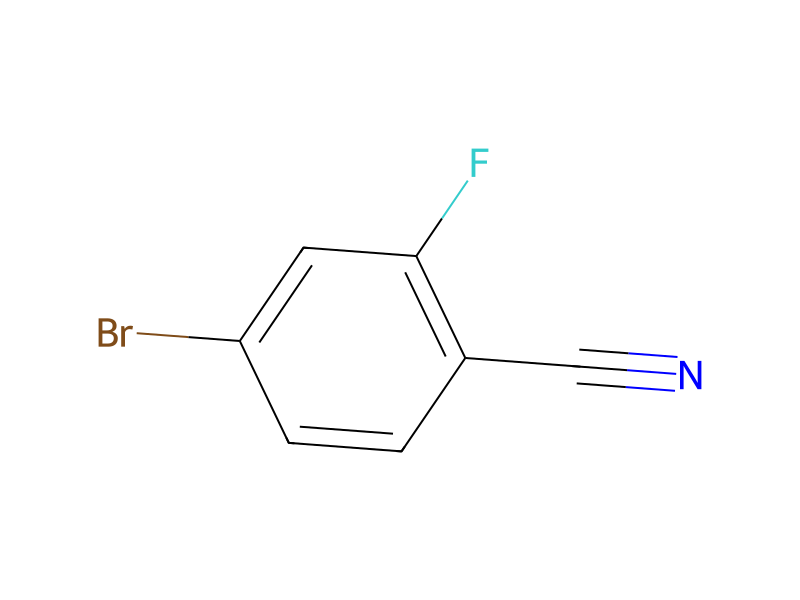
To a dried flask charged with 4-bromo-2-fluorobenzonitrile (4.0 g, 18.0 mmol) in n-butanol (60 mL) was added a solution of phenylhydrazine hydrochloride (10.4 g, 72.0 mmol, 4.0 eq) and diisopropylethylamine (13.2 mL, 75.6 mmol, 4.2 eq) in n-butanol (35 mL). The reaction mixture was stirred at 140° C. under N2 for 3 days. The mixture was cooled to rt and partitioned between EtOAc and water. The organic layer was washed with water and brine, dried over Na2SO4, filtered, and concentrated in vacuo. The crude product was purified using an ISCO® instrument (gradient 10 to 65% EtOAc/hexane) and the product containing fractions were concentrated. Crystallization from DCM-hexane afforded 1.33 g (26%) of the title compound as beige solid. 1H NMR (300 MHz, DMSO-d6) δ 7.71 (d, 1H), 7.69 to 7.66 (m, 2H), 7.58 to 7.54 (m, 2H), 7.47 to 7.44 (m, 2H), 6.78 (dd, 1H), 6.50 (s, 2H); ES-MS m/z 288.1/290.1 [M+H]+, RT (min) 2.28.