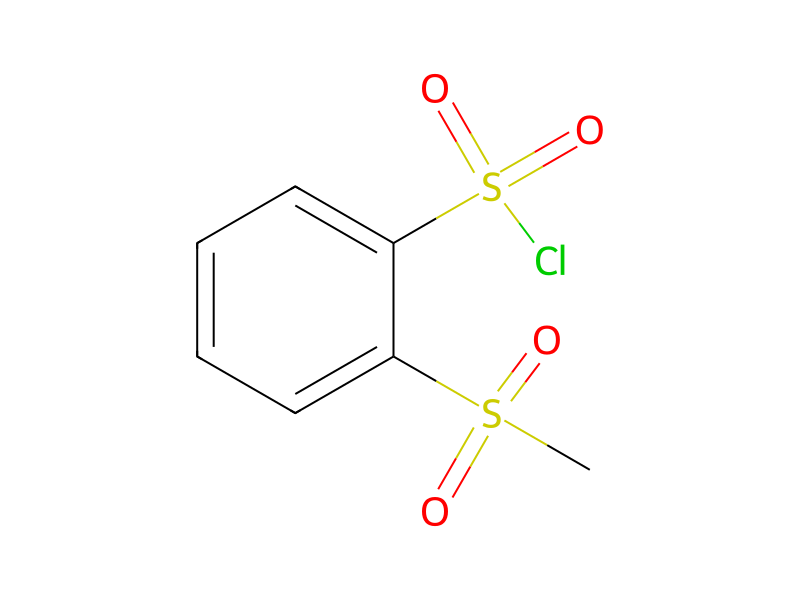
O.[C:2]1([OH:10])[CH:9]=[C:7]([CH3:8])[CH:6]=[C:4]([OH:5])[CH:3]=1.[CH3:11][S:12]([C:15]1[CH:20]=[CH:19][CH:18]=[CH:17][C:16]=1[S:21](Cl)(=[O:23])=[O:22])(=[O:14])=[O:13]>C([O-])(O)=O.[Na+].ClCCl.O>[CH3:8][C:7]1[CH:9]=[C:2]([O:10][S:21]([C:16]2[CH:17]=[CH:18][CH:19]=[CH:20][C:15]=2[S:12]([CH3:11])(=[O:14])=[O:13])(=[O:23])=[O:22])[CH:3]=[C:4]([OH:5])[CH:6]=1A mixture of orcinol monohydrate (1.68 g, 12 mmol) and 2-methylsulfonylbenzenesulfonyl chloride (3.0 g, 11.8 mmol) in saturated NaHCO3 (25 mL) and dichloromethane (25 mL) was stirred vigorously at room temperature for one week. The reaction mixture was diluted with 50 mL of water and extracted into dichloromethane (3×50 mL). The organic phase was washed with brine (2×50 mL) and dried over Na2SO4. After removing the solvent in vacuo, the residue was treated with dichloromethane and ether to initiate crystallization. The mixture was filtered to provide 1.05 g (26% yield) of a white solid. 1H-NMR (300 MHz, CDCl3) δ2.22 (s, 3H), 3.45 (s, 3H), 5.20 (s, 1H), 6.51 (t, 1H), 6.54 (s, H), 6.61 (s, 1H), 7.74 (td, 1H, J=7.7, 1.4 Hz), 7.87 (td, 1H, J=7.7, 1.3 Hz), 8.12 (dd, 1H, J=7.8, 0.7 Hz), and 8.44 (dd, 1H, J=7.8, 0.5 Hz).