Reaction equation
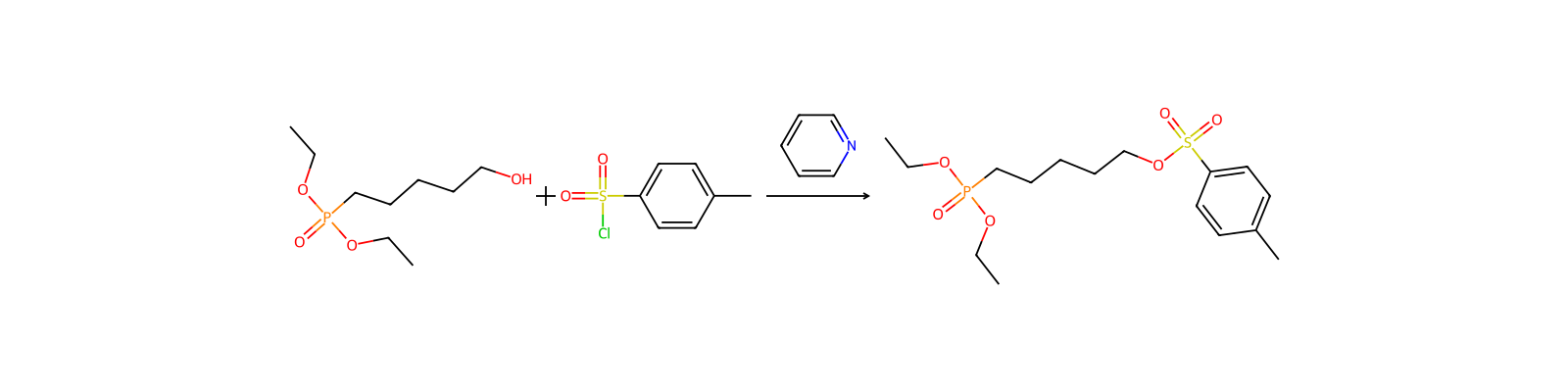
[OH:1][CH2:2][CH2:3][CH2:4][CH2:5][CH2:6][P:7](=[O:14])([O:11][CH2:12][CH3:13])[O:8][CH2:9][CH3:10].[C:15]1([CH3:25])[CH:20]=[CH:19][C:18]([S:21](Cl)(=[O:23])=[O:22])=[CH:17][CH:16]=1>N1C=CC=CC=1>[C:15]1([CH3:25])[CH:20]=[CH:19][C:18]([S:21]([O:1][CH2:2][CH2:3][CH2:4][CH2:5][CH2:6][P:7](=[O:14])([O:8][CH2:9][CH3:10])[O:11][CH2:12][CH3:13])(=[O:23])=[O:22])=[CH:17][CH:16]=1Participants
4
Reactant 2


Product 1

Reagents, catalysts & solvents 1

Conditions
- Temperature
- 0 °C
Procedure
30 g (0.134 mol) of diethyl 5-hydroxypentylphosphonate (see Example 21) were dissolved in 200 ml of pyridine, and the solution was cooled to 0° C. and treated with stirring with 26.1 g (0.134 mol) of 4-toluenesulfonyl chloride. The reaction mixture was concentrated under reduced pressure, taken up in ethyl acetate, washed several times with 20% strength citric acid solution and water and dried over sodium sulfate. After evaporating the solvent, a pale yellow oil remained, which was employed without further purification.
Workup
- additiontreated
- concentrationThe reaction mixture was concentrated under reduced pressure
- washwashed several times with 20% strength citric acid solution and water
- dry with materialdried over sodium sulfate
- customAfter evaporating the solvent
- customwhich was employed without further purification
Sources & evidence
- ORD record
- ord-6aa4458a36274254b109c6155ed0e1f1
- Source dataset
- uspto-grants-1998_03
- Patent number
- US05728686
Linked notes
Loading…