Reaction equation
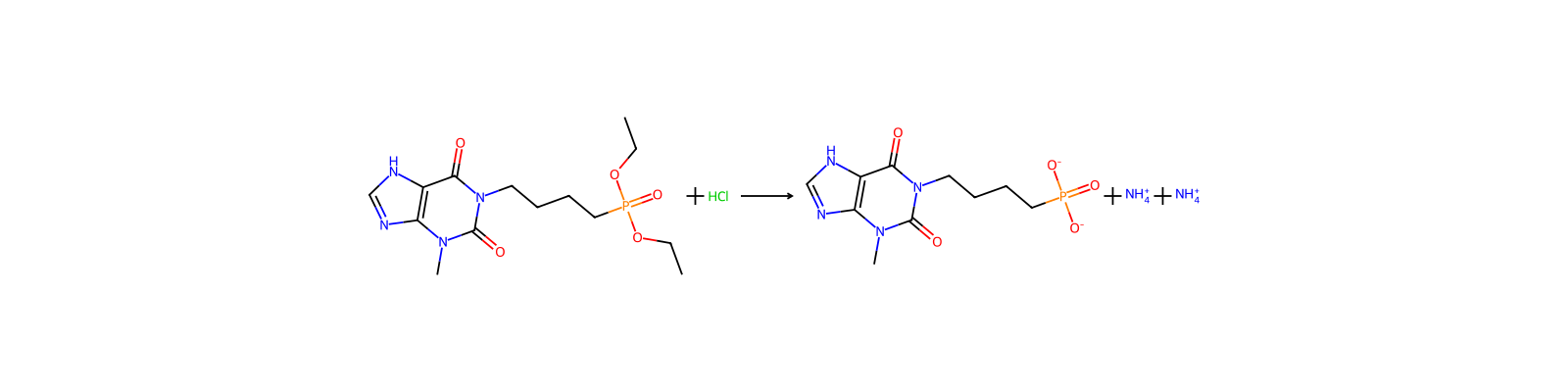
[CH3:1][N:2]1[C:10]2[N:9]=[CH:8][NH:7][C:6]=2[C:5](=[O:11])[N:4]([CH2:12][CH2:13][CH2:14][CH2:15][P:16](=[O:23])([O:20]CC)[O:17]CC)[C:3]1=[O:24].Cl>>[CH3:1][N:2]1[C:10]2[N:9]=[CH:8][NH:7][C:6]=2[C:5](=[O:11])[N:4]([CH2:12][CH2:13][CH2:14][CH2:15][P:16](=[O:17])([O-:20])[O-:23])[C:3]1=[O:24].[NH4+:2].[NH4+:2]Participants
3



Procedure
5.2 g (0.0125 mol) of diethyl [4-(3-methylxanthin-1-yl)butyl]phosphonate were heated under reflux with 30 ml of 20% strength hydrochloric acid for 4 hours. The hydrochloric acid was evaporated and the oily residue was dried over potassium hydroxide in a desiccator. The phosphonic acid formed was then treated with a methanolic ammonia solution, the solvent was evaporated and the residue was crystallized from a methanol/diisopropyl ether mixture.
Workup
- customThe hydrochloric acid was evaporated
- dry with materialthe oily residue was dried over potassium hydroxide in a desiccator
Sources & evidence
- ORD record
- ord-ed605b1432c04b18a421b64e3ecf749d
- Source dataset
- uspto-grants-1998_03
- Patent number
- US05728686
Linked notes
Loading…