HomeMCPWorkbenchSkills
HomeWorkbenchNotificationsMe
llms.txt · MCP GuidePrivacy Policy · Terms of Service · Supportv1.8.3
  1. Home
  2. /Reaction

Pentane → {4-[(Bicyclo[2.2.1]hept-5-en-2-yl)methoxy]phenyl}(diphenyl)phosphane

HRID 2035317
Print

Reaction equation

HRID 2035317 reaction equation
I[C:2]1[CH:7]=[CH:6][C:5]([O:8][CH2:9][CH:10]2[CH2:15][CH:14]3[CH2:16][CH:11]2[CH:12]=[CH:13]3)=[CH:4][CH:3]=1.CCCCC.[C:22]1([P:28]([C:33]2[CH:38]=[CH:37][CH:36]=[CH:35][CH:34]=2)[Si](C)(C)C)[CH:27]=[CH:26][CH:25]=[CH:24][CH:23]=1>C1(C)C=CC=CC=1.CC#N.CC#N.Cl[Pd]Cl>[CH:11]12[CH2:16][CH:14]([CH:13]=[CH:12]1)[CH2:15][CH:10]2[CH2:9][O:8][C:5]1[CH:6]=[CH:7][C:2]([P:28]([C:33]2[CH:34]=[CH:35][CH:36]=[CH:37][CH:38]=2)[C:22]2[CH:27]=[CH:26][CH:25]=[CH:24][CH:23]=2)=[CH:3][CH:4]=1
ParticipantsConditionsProcedureWorkupSources & evidenceReaction notes

Participants

6

Reactant 3

HCID 8003PentaneHCID 140190Diphenyl(trimethylsilyl)phosphineHCID 219893005-[(4-Iodophenoxy)methyl]bicyclo[2.2.1]hept-2-ene

Product 1

HCID 21989303{4-[(Bicyclo[2.2.1]hept-5-en-2-yl)methoxy]phenyl}(diphenyl)phosphaneYield 14.7%

Reagents, catalysts & solvents 2

HCID 6093782
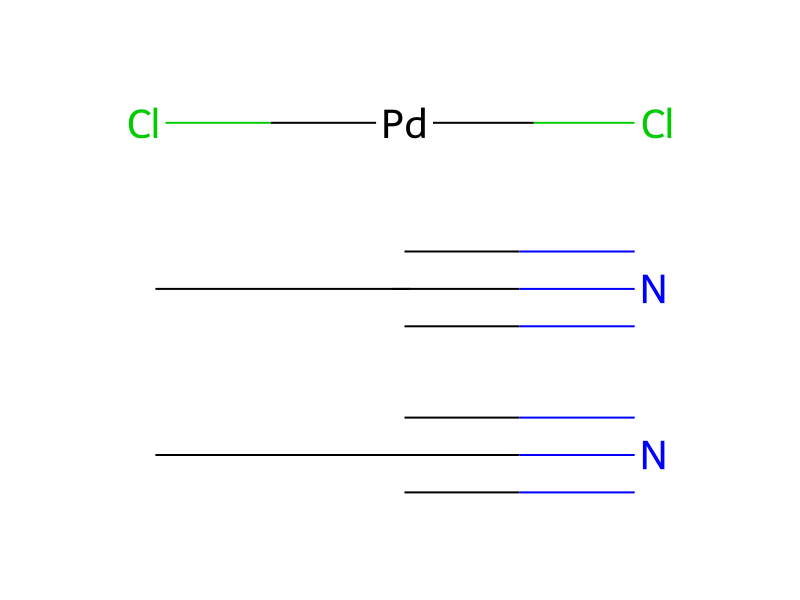
Bis(acetonitrile)dichloropalladium
Catalyst
HCID 1140TolueneSolvent

Conditions

Temperature
70 °C

Procedure

Bis(acetonitrile)dichloropalladium(II) (1 mmol) was placed in a Schlenk flask, stoppered with a septum and evacuated and purged with nitrogen three times. To this flask was then added a solution of 8 (0.038 mol) in 100 mL of anhydrous toluene and 9.6 g of diphenyl(trimethylsilyl)phosphine. The resulting deep purple solution was heated at 70° C. overnight, then cooled to room temperature and the solvent evaporated under reduced pressure. The residue was chromatographed on a column of silica gel using first hexane and then 9:1 hexane ethyl acetate as eluent to collect the product. After evaporation of the solvent, the product 9 (10 g), a mixture of endo and exo isomers, was obtained as white gummy material. Addition of 50 mL of hot pentane to this compound resulted in the separation of white crystalline compound (2.1 g). 1H NMR (500 MHz, 25° C., CDCl3): δ (endo isomer, ˜85%) 7.30 (m, 12H, Ar—H), 6.88 (m, 2H, Ar—H), 6.18 (m, 1H, olefinic), 5.98 (m, 1H, olefinic), 3.72 (m, 1H, nor-CH2), 3.57 (m 1H, nor-CH2), 3.04 (br s 1H), 2.88 (br s, 1H), 2.53 (m, 1H), 1.92 (m, 1H), 1.51 (d, |J|=8.0 Hz), 1.32 (d, |J|=8.2 Hz, 1H), 0.65 (m, 1H); (exo isomer, partial) 6.92 (m, 2H, Ar—H), 4.05 (m, 1H), 3.88 (m, 1H). 31P {1H} NMR (200 MHz, 25° C., CDCl3): δ −6.57

Workup

  1. customevacuated
  2. custompurged with nitrogen three times
  3. temperaturecooled to room temperature
  4. customthe solvent evaporated under reduced pressure
  5. customThe residue was chromatographed on a column of silica gel using first hexane
  6. custom9:1 hexane ethyl acetate as eluent to collect the product
  7. customAfter evaporation of the solvent
  8. additionthe product 9 (10 g), a mixture of endo and exo isomers
  9. customwas obtained as white gummy material

Sources & evidence

ORD record
ord-4a5cb7caa99746bfb61f14b73d2a214b
Source dataset
uspto-grants-2013_11
DOI
10.6084/m9.figshare.5104873.v1
Patent number
US08574680B2

Reaction notes

On this pageParticipantsConditionsProcedureWorkupSources & evidenceReaction notes