4-Nitrophenyl chloroformate → (4-nitrophenyl) (S)-2-(N-(tert-butoxycarbonyl)amino)-3-((R)-tetrahydro-2H-pyran-3-yl)propylcarbamate
Reaction equation

[NH2:1][CH2:2][C@@H:3]([NH:11][C:12](=[O:18])[O:13][C:14]([CH3:17])([CH3:16])[CH3:15])[CH2:4][C@H:5]1[CH2:10][CH2:9][CH2:8][O:7][CH2:6]1.Cl[C:20]([O:22][C:23]1[CH:28]=[CH:27][C:26]([N+:29]([O-:31])=[O:30])=[CH:25][CH:24]=1)=[O:21]>C(Cl)Cl>[C:14]([O:13][C:12]([NH:11][C@@H:3]([CH2:4][C@H:5]1[CH2:10][CH2:9][CH2:8][O:7][CH2:6]1)[CH2:2][NH:1][C:20](=[O:21])[O:22][C:23]1[CH:24]=[CH:25][C:26]([N+:29]([O-:31])=[O:30])=[CH:27][CH:28]=1)=[O:18])([CH3:15])([CH3:17])[CH3:16]Participants
4
Reactant 2
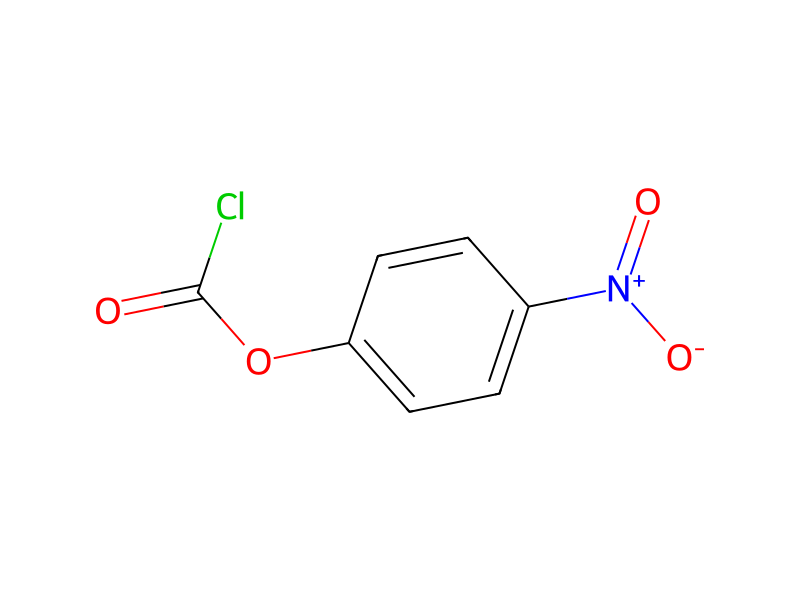

Product 1

Reagents, catalysts & solvents 1

Procedure
To a solution of tert-butyl (S)-1-amino-3-((R)-tetrahydro-2H-pyran-3-yl)propan-2-ylcarbamate (20.8 mg, 0.081 mmol) in anhydrous DCM (9 mL) was added 4-nitrophenyl chloroformate (17.1 mg, 0.085 mmol), followed by TEA (12.2 mg, 17 μL, 0.12 mmol). The resulting solution was stirred at rt for 5 min (monitored by LC-MS) and diluted to 12 mL. An aliquot of the carbamate mixture solution (2 mL) was used for the next step without purification.