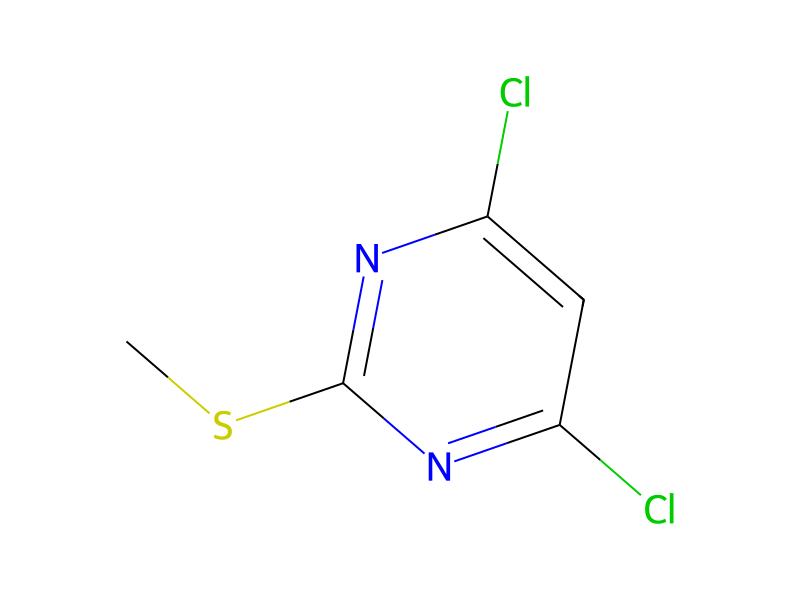
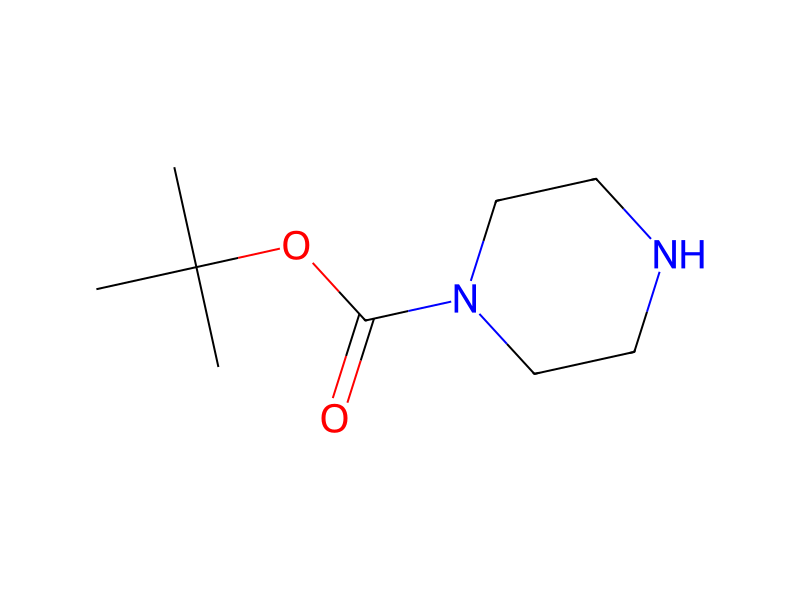
Cl[C:2]1[CH:7]=[C:6]([Cl:8])[N:5]=[C:4]([S:9][CH3:10])[N:3]=1.C(N(CC)CC)C.[C:18]([O:22][C:23]([N:25]1[CH2:30][CH2:29][NH:28][CH2:27][CH2:26]1)=[O:24])([CH3:21])([CH3:20])[CH3:19]>ClCCl>[C:18]([O:22][C:23]([N:25]1[CH2:30][CH2:29][N:28]([C:2]2[CH:7]=[C:6]([Cl:8])[N:5]=[C:4]([S:9][CH3:10])[N:3]=2)[CH2:27][CH2:26]1)=[O:24])([CH3:21])([CH3:19])[CH3:20]4,6-Dichloro-2-methylsulfanylpyrimidine (10 g) was dissolved in dichloromethane (200 ml) and triethylamine (20.6 g) was added. The mixture was stirred at room temperature and piperazine-1-carboxylic acid tert-butyl ester (9.54 g) was added in portions. The mixture was stirred at room temperature overnight. Mixture was washed with water (200 ml) then brine (100 ml). The organic layer was dried (MgSO4) then evaporated under reduced pressure to afford 4-(6-chloro-2-methylsulfanyl-pyrimidin-4-yl)-piperazine-1-carboxylic acid tert-butyl ester (17.9 g) as a white solid. 1H NMR (CDCl3): δ 6.11 (s, 1H), 3.58 (m, 4H), 3.44 (m, 4H), 2.42 (s, 3H), 1.41 (s, 9H).