Reaction equation

[CH:1]1[C:14]2[CH:13]([CH:15]=[O:16])[C:12]3[C:7](=[CH:8][CH:9]=[CH:10][CH:11]=3)[CH:6]([CH:17]=[O:18])[C:5]=2[CH:4]=[CH:3][CH:2]=1.C(N(CC)CC)C>C(#N)C>[CH:8]1[C:7]2[C:12](=[C:13]([CH:15]=[O:16])[C:14]3[C:5]([C:6]=2[CH:17]=[O:18])=[CH:4][CH:3]=[CH:2][CH:1]=3)[CH:11]=[CH:10][CH:9]=1Participants
4
Reactant 2


Product 1
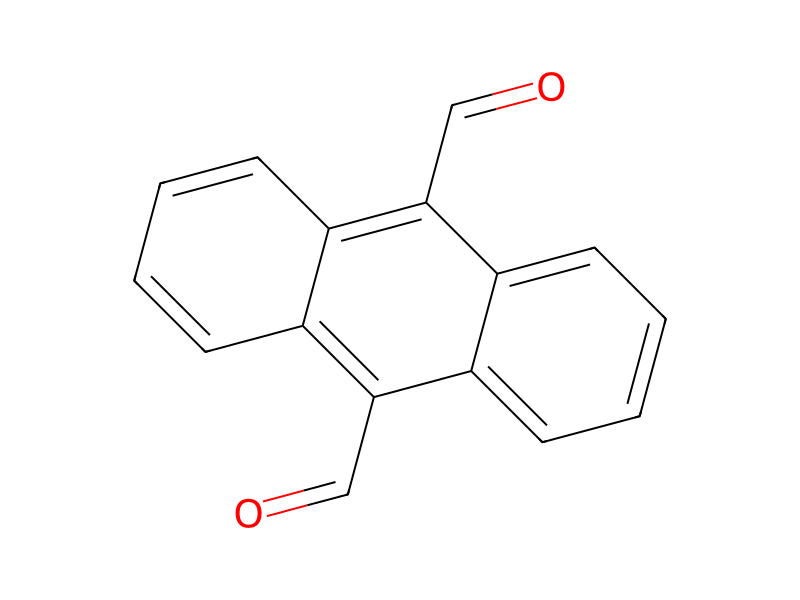
Reagents, catalysts & solvents 1

Procedure
To a solution of 240 mg. of the product of Example 2 (prepared as described) in 15 ml. of acetonitrile is added a solution of 0.30 ml. of triethylamine in 5 ml. of acetonitrile. The reaction mixture is stirred at room temperature for 4 hours then is cooled in an ice bath. The precipitate is collected by filtration to give 136 mg. of the desired crude product as orange crystals, mp. 224°-228° C.
Workup
- temperaturethen is cooled in an ice bath
- filtrationThe precipitate is collected by filtration
- customto give 136 mg
Sources & evidence
- ORD record
- ord-a8c2e8a12ed643ba857366931310ed63
- Source dataset
- uspto-grants-1980_07
- Patent number
- US04211726
Linked notes
Loading…