Triethylamine → HCID 12928950, compound
HRID 2057938
Reaction equation

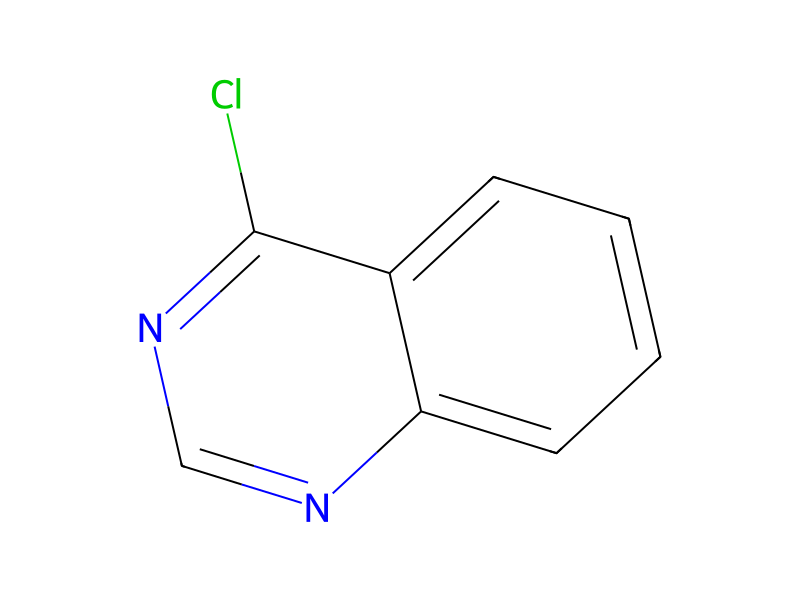
Cl[C:2]1[C:11]2[C:6](=[CH:7][CH:8]=[CH:9][CH:10]=2)[N:5]=[CH:4][N:3]=1.C(N(CC)CC)C.[Br:19][C:20]1[CH:25]=[CH:24][C:23]([S:26][CH2:27][CH2:28][NH2:29])=[CH:22][CH:21]=1>C1C=CC=CC=1>[Br:19][C:20]1[CH:21]=[CH:22][C:23]([S:26][CH2:27][CH2:28][NH:29][C:2]2[C:11]3[C:6](=[CH:7][CH:8]=[CH:9][CH:10]=3)[N:5]=[CH:4][N:3]=2)=[CH:24][CH:25]=1Participants
5
Reactant 3


Product 1

Reagents, catalysts & solvents 1

Procedure
To a solution of 2.5 g (0.015 mol) of 4-chloroquinazoline in 50 ml of benzene were added 1.5 g (0.015 mol) of triethylamine and 3.5 g (0.015 mol) of 2-(p-bromophenylthio) ethylamine, and the mixture was heated, with stirring, at 70°~80° C. for 3 hours. After completion of the reaction, the benzene was evaporated under reduced pressure and the resulting crystals were washed with water, collected by filtration and recrystallized from ethanol, giving 3.0 g of 4-[2-(4-bromophenylthio)ethyl]aminoquinazoline in the form of colorless granules.