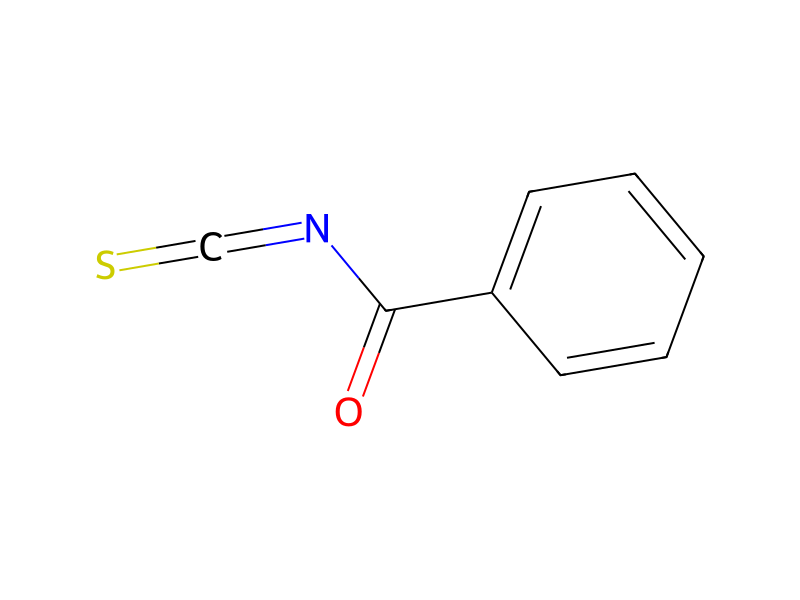
Benzoyl isothiocyanate → 1-Benzoyl-3-(5-benzyloxy-2-bromo-4-methyl-phenyl)-thiourea
HRID 2068706
Reaction equation

[CH2:1]([O:8][C:9]1[C:10]([CH3:17])=[CH:11][C:12]([Br:16])=[C:13]([NH2:15])[CH:14]=1)[C:2]1[CH:7]=[CH:6][CH:5]=[CH:4][CH:3]=1.[C:18]([N:26]=[C:27]=[S:28])(=[O:25])[C:19]1[CH:24]=[CH:23][CH:22]=[CH:21][CH:20]=1>CC(C)=O>[C:18]([NH:26][C:27]([NH:15][C:13]1[CH:14]=[C:9]([O:8][CH2:1][C:2]2[CH:3]=[CH:4][CH:5]=[CH:6][CH:7]=2)[C:10]([CH3:17])=[CH:11][C:12]=1[Br:16])=[S:28])(=[O:25])[C:19]1[CH:24]=[CH:23][CH:22]=[CH:21][CH:20]=1Participants
4
Reactant 2

Product 1

Reagents, catalysts & solvents 1

Procedure
To a solution of 5-benzyloxy-2-bromo-4-methyl-phenylamine (0.50 g, 1.71 mmol) in acetone (20 mL) was added benzoylisothiocyanate (0.28 mL, 2.08 mmol) dropwise at room temperature. The resulting reaction mixture was stirred for 30 min. at the same temperature. After completion of reaction (TLC monitoring), acetone was distilled off, the solid residue was stirred in hexane for 5-10 min and then filtered to obtain the desired product as white solid (0.70 g, 88%). 1H NMR (400 MHz, DMSO-d6): δ 2.20 (s, 3H), 5.10 (s, 2H), 7.33 (m, 1H), 7.40 (t, J=7.20 Hz, 2H), 7.48 (d, J=7.60 Hz, 2H), 7.55 (m, 3H), 7.67 (m, 1H), 7.73 (s, 1H), 8.0 (d, J=7.20 Hz, 2H), 11.81 (br s, 1H) and 12.59 (br s, 1H).