HomeMCPWorkbenchSkills
HomeWorkbenchNotificationsMe
llms.txt · MCP GuidePrivacy Policy · Terms of Service · Supportv1.8.3
  1. Home
  2. /Reaction

Cesium carbonate → 2-(5-chloro-2-nitrophenylamino)-6-(pyridin-4-yl)-9-(tetrahydro-2H-pyran-4-yl)-7H-purin-8(9H)-one

HRID 2074159
Print

Reaction equation

HRID 2074159 reaction equation
[NH2:1][C:2]1[N:10]=[C:9]2[C:5]([NH:6][C:7](=[O:17])[N:8]2[CH:11]2[CH2:16][CH2:15][O:14][CH2:13][CH2:12]2)=[C:4]([C:18]2[CH:23]=[CH:22][N:21]=[CH:20][CH:19]=2)[N:3]=1.C(=O)([O-])[O-].[Cs+].[Cs+].C1C=CC(P(C2C(C3C(P(C4C=CC=CC=4)C4C=CC=CC=4)=CC=C4C=3C=CC=C4)=C3C(C=CC=C3)=CC=2)C2C=CC=CC=2)=CC=1.Br[C:77]1[CH:82]=[C:81]([Cl:83])[CH:80]=[CH:79][C:78]=1[N+:84]([O-:86])=[O:85]>C1(C)C=CC=CC=1.CC([O-])=O.CC([O-])=O.[Pd+2].CS(C)=O>[Cl:83][C:81]1[CH:80]=[CH:79][C:78]([N+:84]([O-:86])=[O:85])=[C:77]([NH:1][C:2]2[N:10]=[C:9]3[C:5]([NH:6][C:7](=[O:17])[N:8]3[CH:11]3[CH2:12][CH2:13][O:14][CH2:15][CH2:16]3)=[C:4]([C:18]3[CH:23]=[CH:22][N:21]=[CH:20][CH:19]=3)[N:3]=2)[CH:82]=1
ParticipantsConditionsProcedureWorkupSources & evidenceReaction notes

Participants

8

Reactant 4

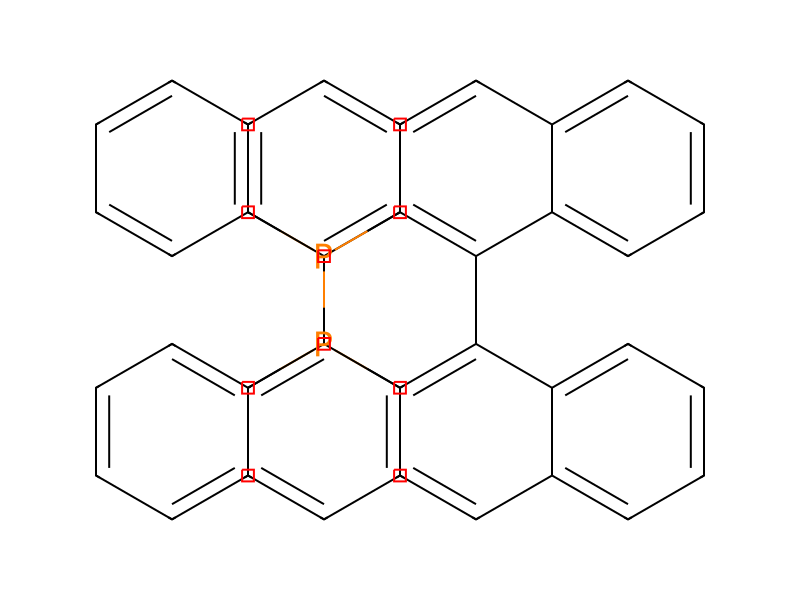
HCID 10796Cesium carbonateHCID 634876Binap, (A+-)-HCID 98561242-Bromo-4-chloro-1-nitrobenzeneHCID 576126402-amino-6-(pyridin-4-yl)-9-(tetrahydro-2H-pyran-4-yl)-7H-purin-8(9H)-one

Product 1

HCID 576127192-(5-chloro-2-nitrophenylamino)-6-(pyridin-4-yl)-9-(tetrahydro-2H-pyran-4-yl)-7H-purin-8(9H)-one
Yield 11%

Reagents, catalysts & solvents 3

HCID 167845palladium(II) acetateCatalystHCID 679Dimethyl SulfoxideSolventHCID 1140TolueneSolvent

Conditions

Temperature
170 °C

Procedure

To an oven-dried vial was added 2-amino-6-(pyridin-4-yl)-9-(tetrahydro-2H-pyran-4-yl)-7H-purin-8(9H)-one (68 mg, 0.22 mmol, 1 equiv.) in anhydrous toluene (1 mL), then freshly grounded cesium carbonate (99.4 mg, 0.31 mmol, 1.4 equiv.) with stirring at room temperature under Ar. After 20 min, Pd(OAc)2 (15 mg, 0.02 mmol, 0.1 equiv.), racemic BINAP (20.5 mg, 0.03 mmol, 0.15 equiv.) and 1-bromo-5-chloro-2-nitrobenzene (WO 02/053545 A1) (67.6 mg, 0.29 mmol, 1.3 equiv.) were added as solids, followed by anhydrous DMSO (1 mL). The vial was purged with Ar for 3 min, then closed and heated in a microwave oven at 170° C. for 45 min. The reaction mixture was cooled to room temperature, diluted with ethyl acetate/methylene chloride, filtered through a Nylon 0.45 μm filter, and the filtrate was concentrated in vacuo. The resulting residue was purified using preparative TLC (silica gel, 7.5% methanol in methylene chloride) to give the desired product as a brown solid (11 mg, 11% yield). 1H NMR (300 MHz, CDCl3+CD3OD) δ, ppm: 9.13 (s, 1H), 8.63 (br m, 2H), 8.13 (d, J=8.9 Hz, 1H), 7.83 (br m, 2H), 6.91 (d, J=8.6 Hz, 1H), 4.70-4.50 (m, 1H), 4.10-4.03 (m, 2H), 3.51-3.43 (m, 2H), 2.68-2.65 (m, 2H), 1.71-1.66 (m, 2H); MS (EI) m/z 468.4 (MH)+.

Workup

  1. customThe vial was purged with Ar for 3 min
  2. customclosed
  3. temperatureThe reaction mixture was cooled to room temperature
  4. additiondiluted with ethyl acetate/methylene chloride
  5. filtrationfiltered through a Nylon 0.45 μm
  6. filtrationfilter
  7. concentrationthe filtrate was concentrated in vacuo
  8. customThe resulting residue was purified

Sources & evidence

ORD record
ord-1d226e9874514b37a9d0950ceb6ef3dc
Source dataset
uspto-grants-2011_04
DOI
10.6084/m9.figshare.5104873.v1
Patent number
US07919490B2

Reaction notes

On this pageParticipantsConditionsProcedureWorkupSources & evidenceReaction notes