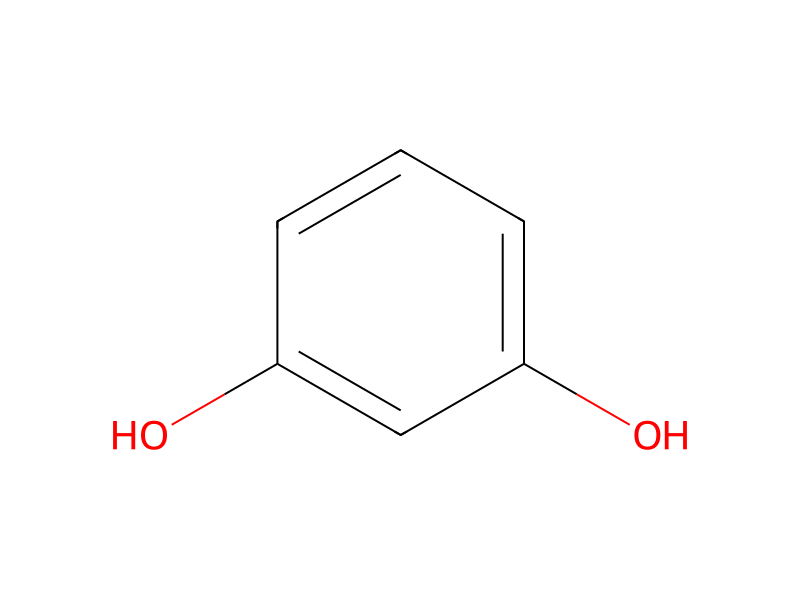
Resorcinol → 2-Methylresorcinol
Reaction equation

C1(C=CC=C(O)C=1)O.C1(C=CC=C(O)C1)O.[CH3:17][CH:18]1[C:23](=[O:24])[CH2:22][CH2:21][CH2:20][C:19]1=[O:25].BrBr.BrC1C=C(Br)C(O)=C(C)C=1O>>[CH3:17][C:18]1[C:19]([OH:25])=[CH:20][CH:21]=[CH:22][C:23]=1[OH:24]Participants
6



Procedure
The synthetic routes to an alkylresorcinol that is partially alkylated at a position other than the 4th position on the aromatic ring are multistep and give low overall yields. For example, a 50% yield of a 2-methylresorcinol is obtained by hydrogenation of resorcinol and methylation of the resulting dihydroresorcinol to 2-methylcyclohexane-1,3-dione which on treatment with bromine is converted into 4,6-dibromo-2-methylresorcinol and finally hydrogenolysis of the dibromo derivative to produce the 2-methylresorcinol. Another example is that 5-methylresorcinol can be prepared by a five-step synthesis starting with p-toluidine or a four-step synthesis starting from ethyl crotonate. The five-step synthesis involves acetylation, two-step nitration, reductive hydrogenation, and hydrolysis.