HomeMCPWorkbenchSkills
HomeWorkbenchNotificationsMe
llms.txt · MCP GuidePrivacy Policy · Terms of Service · Supportv1.8.3
  1. Home
  2. /Reaction

Chlorotrimethylsilane → 1-Bromo-4-(3,3,4,4,5,5,6,6,7,7,8,8,8-tridecafluorooctyl)benzene

HRID 2087125
Print

Reaction equation

HRID 2087125 reaction equation
Br[CH2:2][CH2:3][Br:4].Cl[Si](C)(C)C.[F:10][C:11]([F:31])([C:15]([F:30])([F:29])[C:16]([F:28])([F:27])[C:17]([F:26])([F:25])[C:18]([F:24])([F:23])[C:19]([F:22])([F:21])[F:20])[CH2:12][CH2:13]I.Br[C:33]1[CH:38]=CC(I)=[CH:35][CH:34]=1>C1COCC1.[Zn].[Pd].C1(P(C2C=CC=CC=2)C2C=CC=CC=2)C=CC=CC=1.C1(P(C2C=CC=CC=2)C2C=CC=CC=2)C=CC=CC=1.C1(P(C2C=CC=CC=2)C2C=CC=CC=2)C=CC=CC=1.C1(P(C2C=CC=CC=2)C2C=CC=CC=2)C=CC=CC=1>[Br:4][C:3]1[CH:35]=[CH:34][C:33]([CH2:13][CH2:12][C:11]([F:31])([F:10])[C:15]([F:29])([F:30])[C:16]([F:28])([F:27])[C:17]([F:25])([F:26])[C:18]([F:24])([F:23])[C:19]([F:22])([F:21])[F:20])=[CH:38][CH:2]=1
ParticipantsConditionsProcedureWorkupSources & evidenceReaction notes

Participants

8

Reactant 4

HCID 6397ChlorotrimethylsilaneHCID 78391,2-DibromoethaneHCID 115221-Bromo-4-iodobenzeneHCID 748881,1,1,2,2,3,3,4,4,5,5,6,6-Tridecafluoro-8-iodooctane

Product 1

HCID 114548901-Bromo-4-(3,3,4,4,5,5,6,6,7,7,8,8,8-tridecafluorooctyl)benzeneYield 56%

Reagents, catalysts & solvents 3

HCID 23994ZincCatalyst
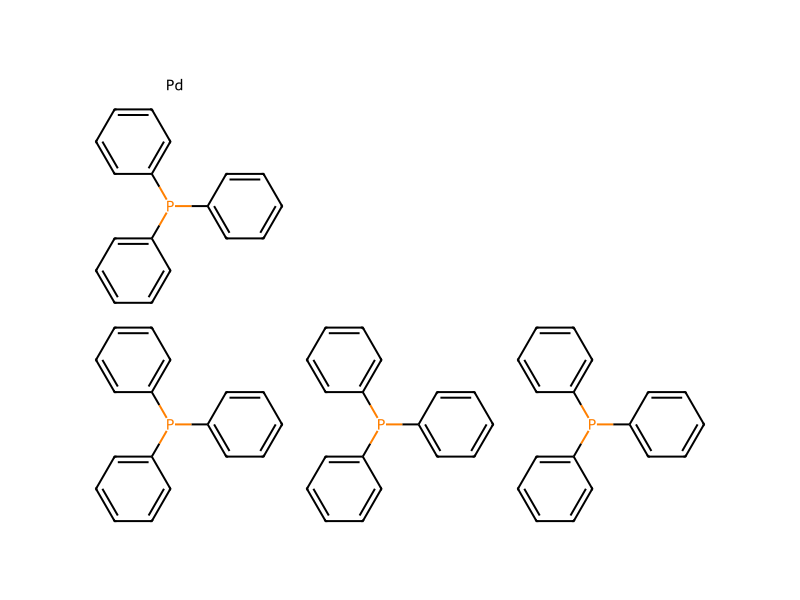
HCID 11979704Tetrakis(triphenylphosphine)palladiumCatalyst
HCID 8028TetrahydrofuranSolvent3×

Conditions

Temperature
65 °C

Procedure

To a 250 mL three-neck flask equipped with dropping funnel was added zinc powder (9.50 g, 146.2 mmol) and dry THF (20 mL) under argon. 1,2-Dibromoethane (0.5 mL) was added and the mixture was heated at 65° C. for 2 min. The mixture was then cooled to room temperature. Chlorotrimethylsilane (0.5 mL) was added and the mixture was stirred at room temperature for 20 min. A solution of 3,3,4,4,5,5,6,6,7,7,8,8,8-tridecafluorooctyl iodide (57.8 g, 126.6 mmol) in dry THF (100 mL) was added dropwise to keep the temperature of the solution at room temperature. The reaction mixture was stirred at room temperature for 12 h. The colorless solution was then transferred via canula to a solution of 1-bromo-4-iodobenzene (35.8 g, 126.6 mmol) and tetrakis(triphenylphosphine) palladium(0) (5.0 g, 4.3 mmol) in THF (60 mL). After 24 h at 45° C., the solvent was removed under vacuum. The residue was dissolved in methylene chloride (50 mL), extracted with FC-72 (50 mL) six times. The combined FC-72 layers were concentrated. Vacuum distillation of the residue gave 8 (34.3 g, 56%) as a colorless liquid. b.p. 79.1-80.9° C./0.03 mmHg; 1H NMR (300 MHz, CDCl3) δ2.36 (tt, J=18.3, 9.1 Hz, 2H), 2.86-2.92 (m, 2H), 7.11 (d, J=8.4 Hz, 2H), 7.45 (d, J=8.4 Hz, 2H); 13C NMR (75 MHz, CDCl3) δ26.1, 32.9 (t, JFC=22.1 Hz), 105.5-123.2 (m, C6F13), 120.7, 130.1, 132.1, 138.3; 19F NMR (282.4 MHz, CDCl3) δ−125.6 (2F), −122.9 (2F), −121.7 (2F), −120.7 (2F), −113.4 (2F), −79.6 (3F); IR (CHCl3) 3065, 2954, 2879, 1490, 1237, 1145, 1013, 810 cm−1; EIMS m/z 502/504 (M+), 423, 169/171 (M—C6F13CH2)+.

Workup

  1. customTo a 250 mL three-neck flask equipped
  2. temperatureThe mixture was then cooled to room temperature
  3. customat room temperature
  4. stirringThe reaction mixture was stirred at room temperature for 12 h
  5. waitAfter 24 h at 45° C.
  6. customthe solvent was removed under vacuum
  7. dissolutionThe residue was dissolved in methylene chloride (50 mL)
  8. extractionextracted with FC-72 (50 mL) six times
  9. concentrationThe combined FC-72 layers were concentrated
  10. distillationVacuum distillation of the residue

Sources & evidence

ORD record
ord-719229510f6f4da48a7b3ba2879c843c
Source dataset
uspto-grants-2004_04
DOI
10.6084/m9.figshare.5104873.v1
Patent number
US06727390B2

Reaction notes

On this pageParticipantsConditionsProcedureWorkupSources & evidenceReaction notes