HomeMCPWorkbenchSkills
HomeWorkbenchNotificationsMe
llms.txt · MCP GuidePrivacy Policy · Terms of Service · Supportv1.8.0
  1. Home
  2. /Reaction

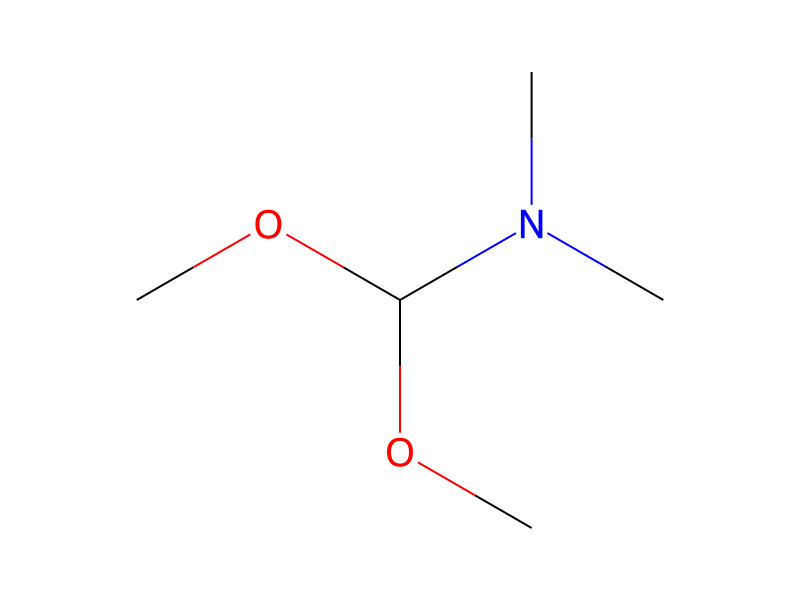
Dimethylformamide dimethyl acetal → methyl 1-(4-methoxyphenyl)-3-(morpholin-4-ylmethyl)-1H-pyrazole-4-carboxylate

HRID 2090923
Notes
Print preview

Reaction equation

HRID 2090923 reaction equation
[N:1]1([CH2:7][C:8](=O)[CH2:9][C:10]([O:12][CH3:13])=[O:11])[CH2:6][CH2:5][O:4][CH2:3][CH2:2]1.[CH3:15]OC(OC)N(C)C.Cl.[CH3:24][O:25][C:26]1[CH:31]=[CH:30][C:29]([NH:32][NH2:33])=[CH:28][CH:27]=1>C(O)C>[CH3:24][O:25][C:26]1[CH:31]=[CH:30][C:29]([N:32]2[CH:15]=[C:9]([C:10]([O:12][CH3:13])=[O:11])[C:8]([CH2:7][N:1]3[CH2:6][CH2:5][O:4][CH2:3][CH2:2]3)=[N:33]2)=[CH:28][CH:27]=1
ParticipantsConditionsProcedureWorkupSources & evidenceReaction notes

Participants

5

Reactant 3

HCID 78373Dimethylformamide dimethyl acetalHCID 27239044-Methoxyphenylhydrazine hydrochlorideHCID 15547736Methyl 4-(morpholin-4-yl)-3-oxobutanoate2×

Product 1

HCID 66778357methyl 1-(4-methoxyphenyl)-3-(morpholin-4-ylmethyl)-1H-pyrazole-4-carboxylateYield 93%

Reagents, catalysts & solvents 1

HCID 702
Ethanol
Solvent

Conditions

Temperature
100 °C

Procedure

To methyl 4-(morpholin-4-yl)-3-oxobutanoate (7.0 g) synthesized in the above-mentioned (1) was added dimethylformamide-dimethylacetal (4.9 mL), and the mixture was stirred at 100° C. for 2 hr. The reaction mixture was allowed to cool to room temperature, ethanol (200 mL) and 4-methoxyphenylhydrazine hydrochloride (6.3 g) were added, and the mixture was stirred at 100° C. for 3 hr. The mixture was allowed to cool to room temperature and the solvent was evaporated under reduced pressure. Water was added to the residue and the mixture was extracted with ethyl acetate. The extract was concentrated, and the residue was purified by silica gel column chromatography (ethyl acetate:hexane=1:2, volume ratio) to give the title object compound (10.6 g, 93%) as a yellow oil.

Workup

  1. temperatureto cool to room temperature
  2. stirringthe mixture was stirred at 100° C. for 3 hr
  3. temperatureto cool to room temperature
  4. customthe solvent was evaporated under reduced pressure
  5. additionWater was added to the residue
  6. extractionthe mixture was extracted with ethyl acetate
  7. concentrationThe extract was concentrated
  8. customthe residue was purified by silica gel column chromatography (ethyl acetate:hexane=1:2, volume ratio)

Sources & evidence

ORD record
ord-e56f9d67d3c54bd783c62f9dc3921b1d
Source dataset
uspto-grants-2013_05
DOI
10.6084/m9.figshare.5104873.v1
Patent number
US08436043B2

Reaction notes

Loading…

On this pageParticipantsConditionsProcedureWorkupSources & evidenceReaction notes