Formic Acid → 3-Hydroxy-3-(thiophen-2-yl)propanenitrile
Reaction equation

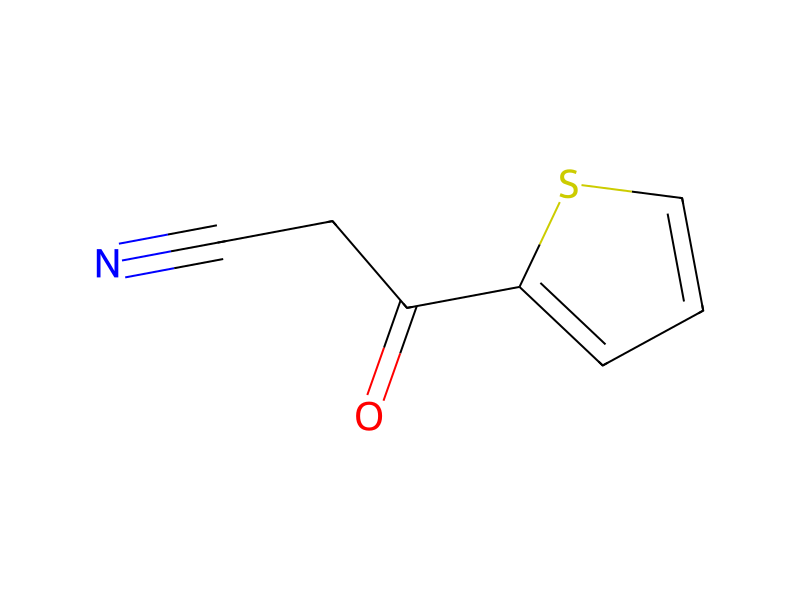
[S:1]1[CH:5]=[CH:4][CH:3]=[C:2]1[C:6](=[O:10])[CH2:7][C:8]#[N:9].C(N(CC)CC)C.C(O)=O>CC1C=CC(C(C)C)=CC=1.CC1C=CC(S([N-][C@H]([C@@H](N)C2C=CC=CC=2)C2C=CC=CC=2)(=O)=O)=CC=1.[Cl-].[Ru+2].O>[S:1]1[CH:5]=[CH:4][CH:3]=[C:2]1[CH:6]([OH:10])[CH2:7][C:8]#[N:9]Participants





Procedure
A 50 ml Schlenk flask was charged with 4.54 g (30.0 mmol) of 3-(2-thienyl)-3-oxopropanenitrile, 10.88 ml (78 mmol) of triethylamine, 3.51 ml (93 mmol) of formic acid, and 19.1 mg (0.03 mmol, S/C=1000) of RuCl[(S,S)-Tsdpen](p-cymene) under an atmosphere of argon, and stirring was carried out at 30° C. for 24 hours. The reaction solution was poured into water and extracted with ether, and the organic layer was washed with saturated brine and then dried with anhydrous sodium sulfate. After removing the drying agent, the solvent was distilled off, and the oil so obtained was purified by silica gel column chromatography (eluant; n-hexane:ethyl acetate=4:1) to give 4.23 g of optically active 3-(2-thienyl)-3-hydroxypropanenitrile. 1H-NMR supported it was the target product and the yield was 92%.
Workup
- extractionextracted with ether
- washthe organic layer was washed with saturated brine
- dry with materialdried with anhydrous sodium sulfate
- customAfter removing the drying agent
- distillationthe solvent was distilled off
- customthe oil so obtained
- customwas purified by silica gel column chromatography (eluant; n-hexane:ethyl acetate=4:1)
Sources & evidence
- ORD record
- ord-a684163af2534d949e713993e2a509cf
- Source dataset
- uspto-grants-2004_02
- Patent number
- US06686505B2
Reaction notes
Loading…