Reaction equation
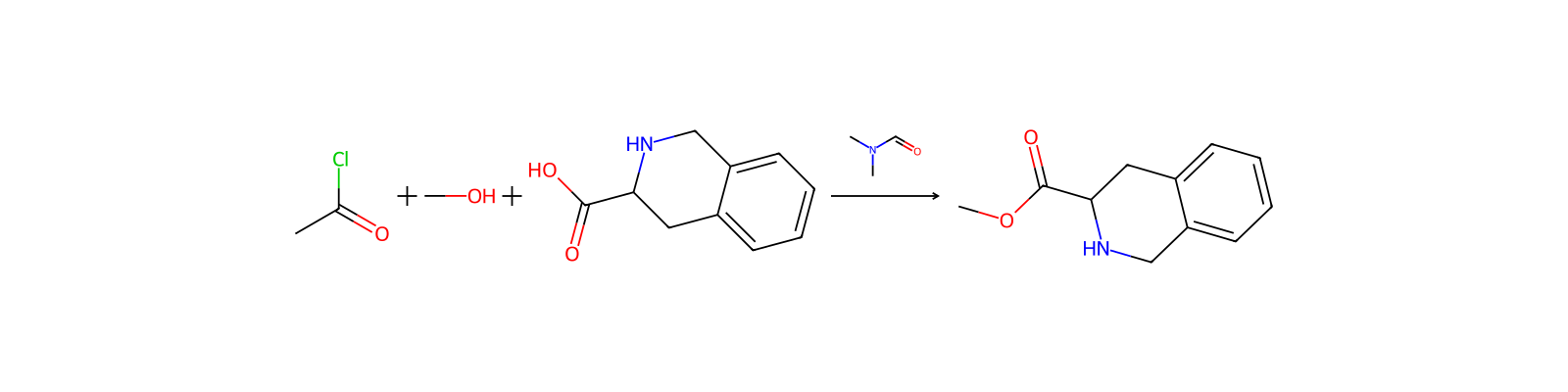
[C:1](Cl)(=O)C.CO.[CH2:7]1[C:16]2[C:11](=[CH:12][CH:13]=[CH:14][CH:15]=2)[CH2:10][CH:9]([C:17]([OH:19])=[O:18])[NH:8]1>CN(C=O)C>[CH3:1][O:18][C:17]([CH:9]1[CH2:10][C:11]2[C:16](=[CH:15][CH:14]=[CH:13][CH:12]=2)[CH2:7][NH:8]1)=[O:19]Participants
5




Conditions
- Temperature
- 0 °C
Procedure
Acetyl chloride (0.88 g) was added to methanol (100 ml) with stirring at 0° C. After 10 minutes, 1,2,3,4-tetrahydroisoquinoline-3-carboxylic acid (J. Am. Chem. Soc., 1962, 48, 4487-4494) (2.0 g) was added; the reaction was allowed to warm to room temperature and stirred overnight. DMF (1 ml) was then added and stirring was then continued for a further 24 h. The solvent was removed in vacuo; dichloromethane was added and the solid thus formed was filtered off and partitioned between dichloromethane (50 ml) and saturated aqueous sodium hydrogen carbonate solution (50 ml). The organic phase was dried (magnesium sulphate), filtered, and the filtrate evaporated in vacuo to yield the title compound as a pale yellow oil (1.0 g).
Workup
- temperatureto warm to room temperature
- stirringstirred overnight
- stirringstirring
- waitwas then continued for a further 24 h
- customThe solvent was removed in vacuo
- additiondichloromethane was added
- customthe solid thus formed
- filtrationwas filtered off
- custompartitioned between dichloromethane (50 ml) and saturated aqueous sodium hydrogen carbonate solution (50 ml)
- dry with materialThe organic phase was dried (magnesium sulphate)
- filtrationfiltered
- customthe filtrate evaporated in vacuo
Sources & evidence
- ORD record
- ord-f942832a149344ee8ae24b50f8c14966
- Source dataset
- uspto-grants-1998_03
- Patent number
- US05728712
Linked notes
Loading…