Reaction equation
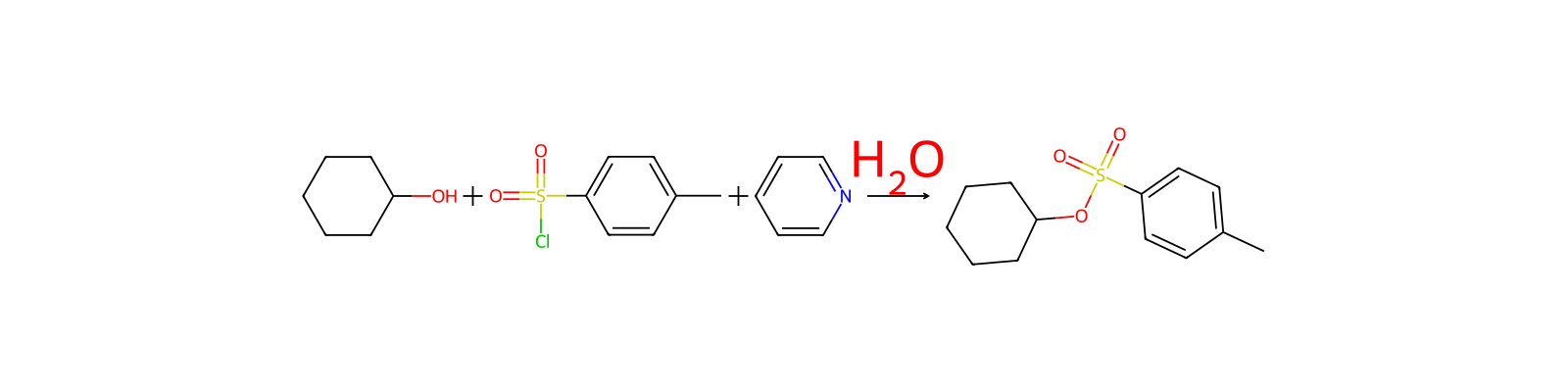
[CH:1]1([OH:7])[CH2:6][CH2:5][CH2:4][CH2:3][CH2:2]1.[C:8]1([CH3:18])[CH:13]=[CH:12][C:11]([S:14](Cl)(=[O:16])=[O:15])=[CH:10][CH:9]=1.N1C=CC=CC=1>O>[C:8]1([CH3:18])[CH:13]=[CH:12][C:11]([S:14]([O:7][CH:1]2[CH2:6][CH2:5][CH2:4][CH2:3][CH2:2]2)(=[O:16])=[O:15])=[CH:10][CH:9]=1Participants
Reactant 3


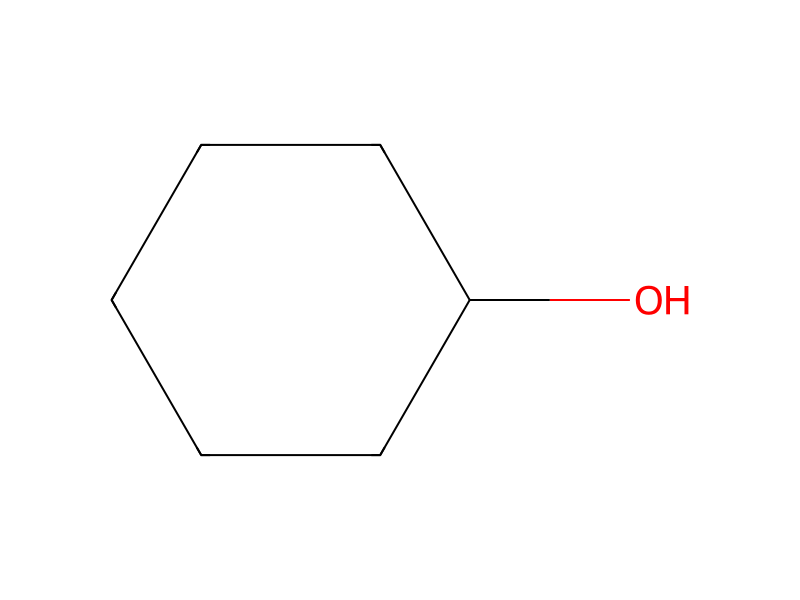
Product 1

Reagents, catalysts & solvents 1

Procedure
Cyclohexanol (5.01 g, 50.0 mmol) and p-toluenesulfonyl chloride (10.6 g, 55.6 mmol) were charged into a 100 cc round-bottom flask, and then pyridine (20 ml) was added dropwise thereto under ice-cooling. The mixture was stirred for 8 hours while gradually elevating the temperature to room temperature. After completion of the reaction, cold water (500 ml) was added to the reaction mixture, and the mixture was extracted with ether (100 ml×3). The organic layers were combined, washed successively with 2N hydrochloric acid, water and a saturated aqueous solution of sodium chloride, and dried with anhydrous magnesium sulfate. The drying agent was separated by filtration, and the solvent was distilled off under reduced pressure to obtain substantially pure cyclohexyl p-toluenesulfonate as a white solid (12.7 g, 49.9 mmol, 99% yield). 1H-NMR Spectrum (CDCl3, TMS, ppm): δ1.00-1.93 (10H, m), 2.43 (3H, s), 4.30-4.64 (1H, m), 7.30 (2H, d, JHF =9.0 Hz) 7.78 (2H, d, JHF =9.0 Hz).
Workup
- temperatureunder ice-cooling
- customto room temperature
- additionwas added to the reaction mixture
- extractionthe mixture was extracted with ether (100 ml×3)
- washwashed successively with 2N hydrochloric acid, water
- dry with materiala saturated aqueous solution of sodium chloride, and dried with anhydrous magnesium sulfate
- customThe drying agent was separated by filtration
- distillationthe solvent was distilled off under reduced pressure
Sources & evidence
- ORD record
- ord-fc0defca77d14e7983bf4dd7897ef3f3
- Source dataset
- uspto-grants-1995_06
- Patent number
- US05424277
Linked notes
Loading…