Benzyl Alcohol → Carbonic acid, 4-nitrophenyl phenylmethyl ester
HRID 2175300
Reaction equation

[CH2:1]([OH:8])[C:2]1[CH:7]=[CH:6][CH:5]=[CH:4][CH:3]=1.[C:9](Cl)(=[O:20])[O:10][C:11]1[CH:16]=[CH:15][C:14]([N+:17]([O-:19])=[O:18])=[CH:13][CH:12]=1>N1C=CC=CC=1>[C:9](=[O:20])([O:10][C:11]1[CH:12]=[CH:13][C:14]([N+:17]([O-:19])=[O:18])=[CH:15][CH:16]=1)[O:8][CH2:1][C:2]1[CH:7]=[CH:6][CH:5]=[CH:4][CH:3]=1Participants
4
Reactant 2

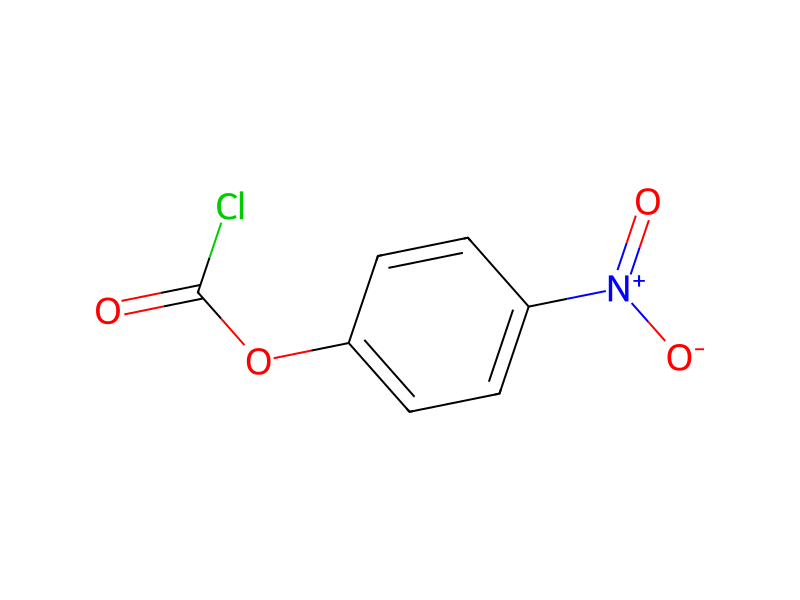
Product 1

Reagents, catalysts & solvents 1

Procedure
Benzyl alcohol was treated with phosgene or similar reagents, such as diphosgene or triphosgene, in the presence of a base, such as DIEA, at 0° C. for 30 min. The solvent was then removed via vacuum and the resulting intermediate carbonochloridate was dissolved in an organic solvent, such as DCM or EtOAc, and then treated with amine in the presence of base, such as Hunig's base or aqueous Na2CO3, to provide the desired carbamate. If required, hydrolysis under a basic condition, such as aqueous LiOH, was used to convert the carbamate to the final product. Alternatively, the benzyl alcohol was treated with 4-nitrophenyl carbonochloridate in the presence of base, such as pyridine, at 0° C. The reaction mixture was slowly warmed to room temperature where it was stirred overnight. After this time, the reaction was quenched with water. The organic layer washed with water and brine, dried over MgSO4 and concentrated in vacuum to provide the crude material. The crude material was purified by silica gel flash chromatography to afford the corresponding benzyl 4-nitrophenyl carbonate. The resulting benzyl 4-nitrophenyl carbonate was then treated with amine in the presence of a base, such as Hunig's base or aqueous Na2CO3, to get the desired carbamate. If required, hydrolysis under a basic condition, such as aqueous LiOH, was used to convert the carbamate to the final product.