1-Butanol → 3-Methyl-4,5-diphenyl-4H-1,2,4-triazole
HRID 2176331
Reaction equation
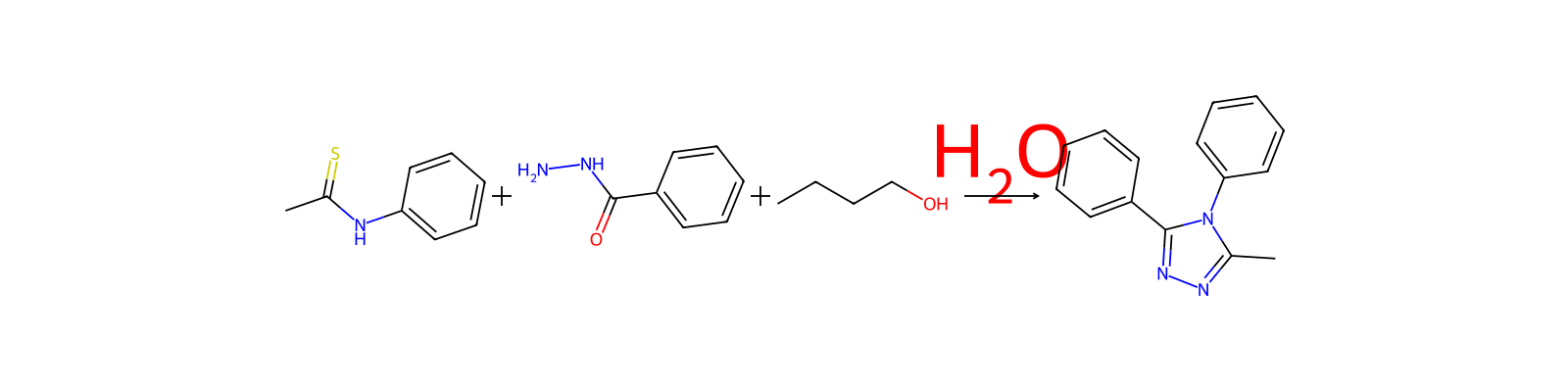
[C:1]([NH:4][C:5]1[CH:10]=[CH:9][CH:8]=[CH:7][CH:6]=1)(=S)[CH3:2].[C:11]([NH:19][NH2:20])(=O)[C:12]1[CH:17]=[CH:16][CH:15]=[CH:14][CH:13]=1.C(O)CCC>O>[CH3:2][C:1]1[N:4]([C:5]2[CH:10]=[CH:9][CH:8]=[CH:7][CH:6]=2)[C:11]([C:12]2[CH:17]=[CH:16][CH:15]=[CH:14][CH:13]=2)=[N:19][N:20]=1Participants
5
Reactant 3



Product 1

Reagents, catalysts & solvents 1

Procedure
First, 5.04 g of thioacetanilide, 5.44 g of benzoylhydrazine, and 50 mL of 1-butanol were put in a round-bottomed flask provided with a reflux pipe, and the air in the flask was replaced with argon. This reaction container was subjected to irradiation with a microwave (2.45 GHz, 100 W) for 2 hours and 45 minutes to be heated. Then, water was added to this solution and an organic layer was extracted from dichloromethane. The organic layer was washed with water and dried with magnesium sulfate. After the drying, the solution was filtrated. The solvent of this solution was distilled off, and the resulting residue was purified by silica gel column chromatography which uses ethyl acetate as a developing solvent, so that 3-methyl-4,5-diphenyl-4H-1,2,4-triazole (abbreviation: HMptz) was prepared (light yellow powder, yield: 18%). The synthetic scheme of Step 1 is shown by (a-1).