HomeMCPSkillsWorkbenchOpenChem
HomeWorkbenchNotificationsMe
llms.txt · skill.md · MCP GuidePrivacy Policy · Terms of Service · Supportv1.8.5
  1. Home
  2. /Reaction

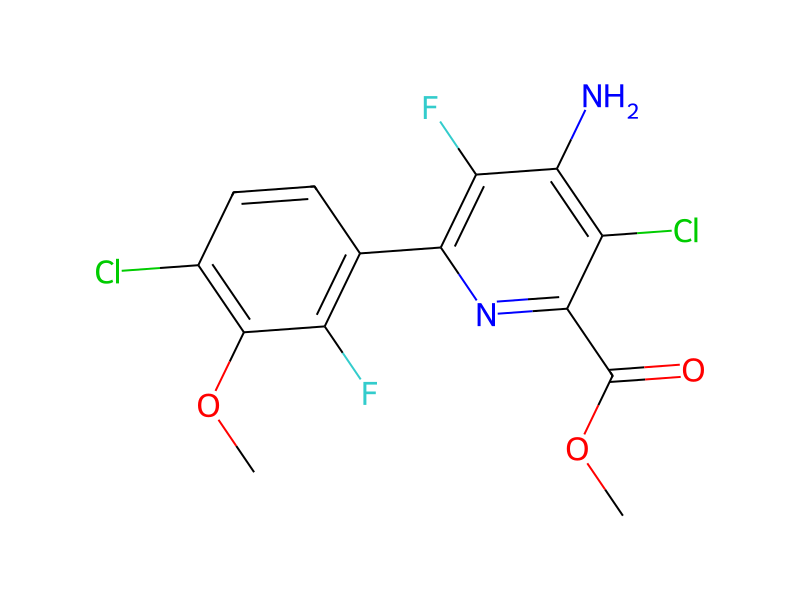
Potassium Fluoride → Methyl 4-amino-3-chloro-6-(4-chloro-2-fluoro-3-methoxyphenyl)-5-fluoropicolinate

HRID 2176821
Print

Reaction equation

[NH2:1][C:2]1[C:7]([F:8])=[C:6](Br)[N:5]=[C:4]([C:10]([O:12][CH3:13])=[O:11])[C:3]=1[Cl:14].[Cl:15][C:16]1[CH:21]=[CH:20][C:19](B2OCCCO2)=[C:18]([F:28])[C:17]=1[O:29][CH3:30].[F-].[K+]>C(#N)C.O>[NH2:1][C:2]1[C:7]([F:8])=[C:6]([C:19]2[CH:20]=[CH:21][C:16]([Cl:15])=[C:17]([O:29][CH3:30])[C:18]=2[F:28])[N:5]=[C:4]([C:10]([O:12][CH3:13])=[O:11])[C:3]=1[Cl:14]
ParticipantsConditionsProcedureWorkupSources & evidenceReaction notes

Participants

6

Reactant 3

HCID 522689Potassium FluorideHCID 577824192-(4-Chloro-2-fluoro-3-methoxyphenyl)-1,3,2-dioxaborinaneHCID 71551894Methyl 4-amino-6-bromo-3-chloro-5-fluoropicolinate

Product 1

HCID 57412076Methyl 4-amino-3-chloro-6-(4-chloro-2-fluoro-3-methoxyphenyl)-5-fluoropicolinateYield 72%

Reagents, catalysts & solvents 2

HCID 962
Water
Solvent
HCID 6342AcetonitrileSolvent

Conditions

Temperature
50 °C

Procedure

A stream of nitrogen was passed through a colorless mixture of methyl 4-amino-6-bromo-3-chloro-5-fluoropicolinate (2.8 g, 10 mmol) and 2-(4-chloro-2-fluoro-3-methoxyphenyl)-1,3,2-dioxaborinane (3.2 g, 13 mmol) in acetonitrile (CH3CN; 40 mL) and KF (1.7 g, 30 mmol) in H2O (20 mL) while heating to 50° C. (20-30 min). Dichloro-bis(triphenylphosphine)palladium(II) (PdCl2(PPh3)2; 140 mg, 0.2 mmol) was added, and the mixture was heated to 65° C. The reaction was monitored by HPLC and was complete after 5 h. The reaction mixture was filtered hot through a short pad of Celite then was diluted with H2O (20 mL) and allowed to cool. The product was collected by filtration. The light tan solid was dried under vacuum to give methyl 4-amino-3-chloro-6-(4-chloro-2-fluoro-3-methoxyphenyl)-5-fluoropicolinate (2.6 g, 72%): mp 169-170.5° C.; 1H NMR (400 MHz, DMSO-d6) δ 7.48 (d, J=8.4 Hz, 1H), 7.32 (t, J=7.7 Hz, 1H), 7.15 (s, 2H), 3.96 (s, 3H), 3.90 (s, 3H); 13C{1H} NMR (101 MHz, DMSO-d6) δ 164.85 (s), 153.11 (d, J=252.5 Hz), 146.29 (s), 144.52 (d, J=4.3 Hz), 143.74 (s), 142.75 (dd, J=227.1, 14.0 Hz), 136.38 (d, J=13.4 Hz), 128.58 (d, J=3.2 Hz), 125.87 (s), 125.54 (d, J=3.5 Hz), 122.89 (dd, J=13.8, 4.0 Hz), 113.01 (d, J=3.0 Hz), 61.61 (d, J=4.2 Hz), 52.70 (s); ESIMS m/z 364 ([M+H]+). Anal. Calcd for C14H10Cl2F2N2O3: C, 46.30; H, 2.78; N, 7.71. Found: C, 46.60; H, 2.68; N, 7.51.


Workup

  1. temperaturethe mixture was heated to 65° C
  2. filtrationThe reaction mixture was filtered hot through a short pad of Celite
  3. additionthen was diluted with H2O (20 mL)
  4. temperatureto cool
  5. filtrationThe product was collected by filtration
  6. customThe light tan solid was dried under vacuum

Sources & evidence

ORD record
ord-2c114cde3e1a49f685c9888abfe1b00f
Source dataset
uspto-grants-2015_06
DOI
10.6084/m9.figshare.5104873.v1
Patent number
US09067890B2

Reaction notes

On this pageParticipantsConditionsProcedureWorkupSources & evidenceReaction notes