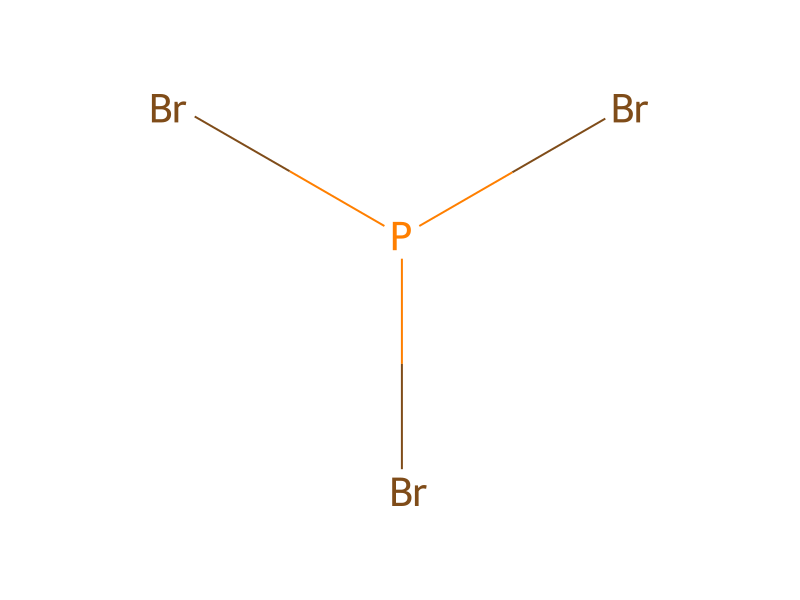
Phosphorus tribromide → 4-Bromo-3-chloroquinoline
HRID 2202687
Reaction equation

[Cl:1][C:2]1[C:11](=O)[C:10]2[C:5](=[CH:6][CH:7]=[CH:8][CH:9]=2)[NH:4][CH:3]=1.P(Br)(Br)[Br:14]>CN(C=O)C>[Br:14][C:11]1[C:10]2[C:5](=[CH:6][CH:7]=[CH:8][CH:9]=2)[N:4]=[CH:3][C:2]=1[Cl:1]Participants
4
Reactant 2

Product 1

Reagents, catalysts & solvents 1

Conditions
- Temperature
- 0 °C
Procedure
To a cooled suspension of 3-chloroquinolin-4(1H)-one (A275-1) (5.15 g, 28.7 mmol) in DMF (43.4 mL) at 0° C. was added phosphorous tribromide (2.77 mL, 29.5 mmol) dropwise over 3 min and then the mixture became orange homogenous mixture. After 4 min, yellow precipitates were formed and the yellow heterogeneous mixture was further stirred at 0° C. for 15 min. After 15 min, the cooling bath was removed and the yellow heterogeneous mixture was stirred at room temperature. After 15 h, the mixture was poured into ice water (300 mL) and stirred at 0° C. for 20 min. The mixture was then neutralized by the addition of 2 M NaOH solution (50 mL) until pH was >9 (pH paper). The resulting precipitate was collected by filtration, washed the solid with water (400 mL), and dried under high vacuum to give 4-bromo-3-chloroquinoline (A275-2) as off-white solid. 1H NMR (400 MHz, DMSO-d6) δ 8.96 (1H, s), 8.20 (1H, dd, J=8.2, 1.6 Hz), 8.12 (1H, dd, J=8.3, 0.9 Hz), 7.81-7.93 (2H, m); LCMS (ESI) m/z 242.0 [M+H (79Br)]+ and 243.9 [M+H (81Br)]+.