HomeMCPWorkbenchSkills
HomeWorkbenchNotificationsMe
llms.txt · MCP GuidePrivacy Policy · Terms of Service · Supportv1.8.3
  1. Home
  2. /Reaction

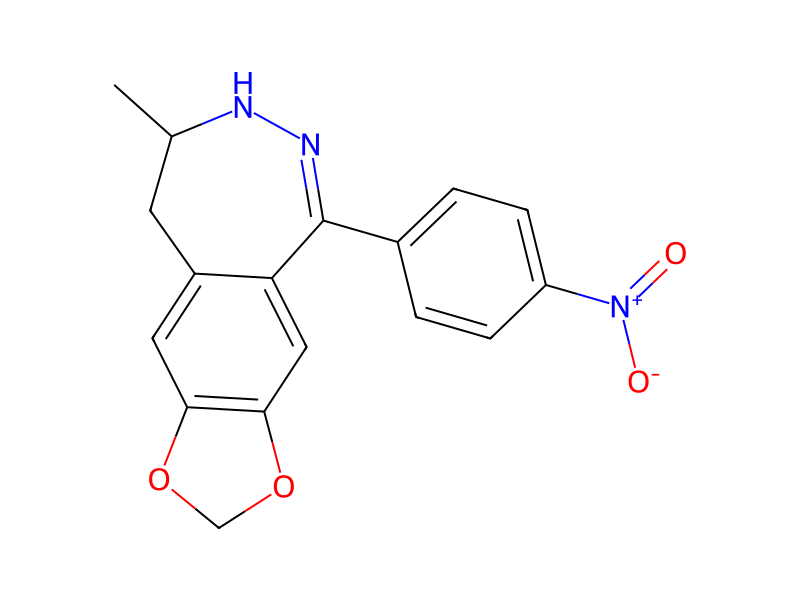
Borane → 1-(4-Nitrophenyl)-4-methyl-7,8-methylenedioxy-3,4-dihydro-5H-2,3-benzodiazepine

HRID 2210516
Print

Reaction equation

HRID 2210516 reaction equation
N[C@@H](C(C)C)C(C1C=CC=CC=1)(C1C=CC=CC=1)O.B.[N+:21]([C:24]1[CH:29]=[CH:28][C:27]([C:30]2[C:36]3[CH:37]=[C:38]4[O:43][CH2:42][O:41][C:39]4=[CH:40][C:35]=3[CH2:34][C:33]([CH3:44])=[N:32][N:31]=2)=[CH:26][CH:25]=1)([O-:23])=[O:22]>C(Cl)Cl.C1COCC1.C(O)C>[N+:21]([C:24]1[CH:25]=[CH:26][C:27]([C:30]2[C:36]3[CH:37]=[C:38]4[O:43][CH2:42][O:41][C:39]4=[CH:40][C:35]=3[CH2:34][CH:33]([CH3:44])[NH:32][N:31]=2)=[CH:28][CH:29]=1)([O-:23])=[O:22]
ParticipantsConditionsProcedureWorkupSources & evidenceReaction notes

Participants

7

Reactant 3

HCID 6331BoraneHCID 854145(S)-(-)-2-Amino-3-methyl-1,1-diphenyl-1-butanolHCID 109362004-nitrophenyl-4-methyl-7,8-methylenedioxy-5H-2,3-benzodiazepine

Product 1

HCID 103364221-(4-Nitrophenyl)-4-methyl-7,8-methylenedioxy-3,4-dihydro-5H-2,3-benzodiazepineYield 88.8%

Reagents, catalysts & solvents 3

HCID 702
Ethanol
Solvent
HCID 6344DichloromethaneSolvent2×
HCID 8028TetrahydrofuranSolvent

Conditions

Temperature
0 °C

Procedure

A solution of (S)-(-)-2-amino-3-methyl-1,1-diphenylbutan-1-ol (4.75 g) in dry methylene chloride was cooled to -70° C. and treated with a solution of borane in THF (1.8M, 9.5 ml) over a 20 minute period under an atmosphere of dry nitrogen. The resulting solution was gradually warmed to 0° C. and allowed to stand overnight at 4° C. This mixture was treated with a solution of 1-(4-nitrophenyl)-4-methyl-7.8-methylenedioxy-5H-2,3-benzodiazepine (5.0 g) in dry methylene chloride (100 ml) at room temperature over a period of about 1 hour. The resulting solution was allowed to stand at room temperature for seven days. The reaction was quenched by the addition of 10% sodium carbonate (15 ml). The resulting phases were separated, and the organic layer washed with water (2×50 ml), dried ever sodium sulfate, and concentrated in vacuo to give a yellow crystalline solid. This solid was suspended in ethanol (50 ml), filtered, and dried to give 4.47 g of the title compound. Proton NMR spectroscopy using a shift reagent (Eu(hfc)3) shows the product as 90:10 mixture of enantiomers. This material was dissolved in hot ethyl acetate (24 ml) and allowed to stand at room temperature overnight. The crystalline precipitate was separated by filtration, washed with ethyl acetate (3×5 ml), and dried to give 2.87 g of the title compound. Proton NMR spectroscopy using a shift reagent (Eu(hfc)3) shows this material to have an enantiomeric purity of more than 98%. Melting point 171°-172.5° C.

Workup

  1. waitto stand at room temperature for seven days
  2. customThe reaction was quenched by the addition of 10% sodium carbonate (15 ml)
  3. customThe resulting phases were separated
  4. washthe organic layer washed with water (2×50 ml)
  5. dry with materialdried ever sodium sulfate
  6. concentrationconcentrated in vacuo
  7. customto give a yellow crystalline solid
  8. filtrationfiltered
  9. customdried

Sources & evidence

ORD record
ord-0a4e90d08d2d49d796df060210469e81
Source dataset
uspto-grants-1995_10
DOI
10.6084/m9.figshare.5104873.v1
Patent number
US05459137

Reaction notes

On this pageParticipantsConditionsProcedureWorkupSources & evidenceReaction notes