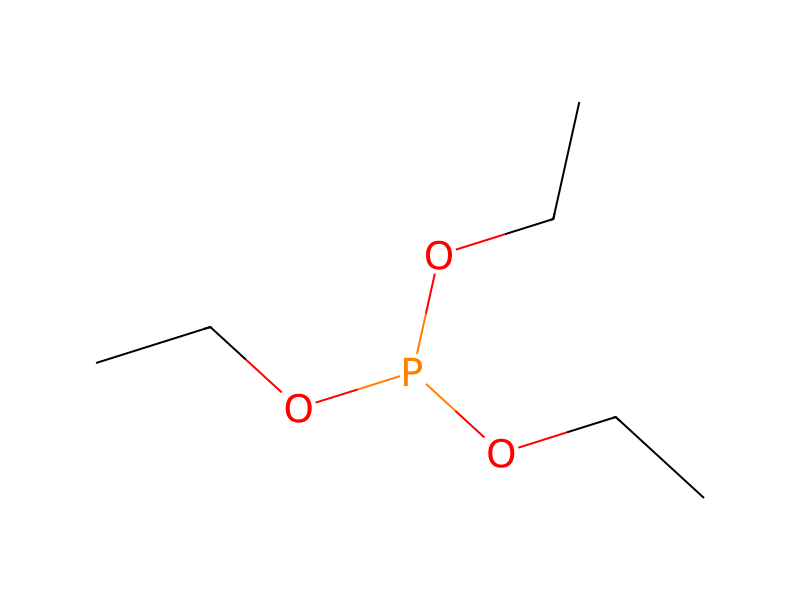
Sodium iodide (100.6 g, 0.66 mol, 1.1 eq.) was added to a solution of 1-bromo-4-pentene (100 g, 0.67 mol) in acetone (250 mL) and the mixture was stirred at room temperature overnight. The mixture was filtered and the solid was washed with acetone. The acetone filtrate and the acetone wash were combined. The acetone was then removed by distillation, revealing 1-iodo-4-pentene, which was used in the next step. 1H NMR (CDCl3) δ=5.8 (m, 1H), 5.0 (m, 2H), 3.2 (t, 2H), 2.2 (sq, 2H), 1.8 (sq, 2H). Triethyl phosphite (400 mL, 2.3 mol, 3.5 eq.) was added to the 1-iodo-4-pentene, and the mixture was heated to 130° C. for three hours. Diethyl ethyl phosphonate was removed by fractional vacuum distillation, revealing the desired 4-pentenyl phosphonic acid diethyl ester which was used without further purification. 1H NMR (CDCl3) δ=5.7 (m, 1H), 4.8 (m, 2H), 4.0 (m, 4H), 2.0 (sq, 2H), 1.7 (m, 4H), 1.2 (t, 6H). 31P NMR (CDCl3) δ=33.3.