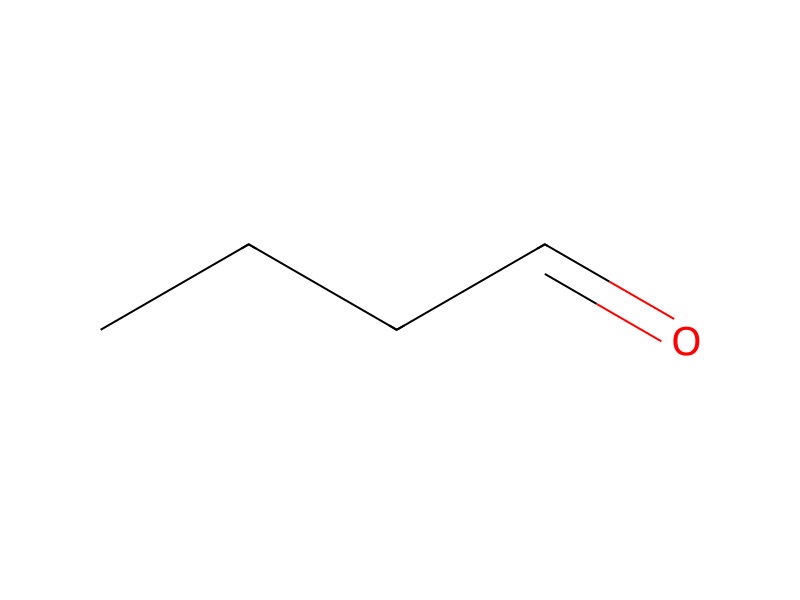
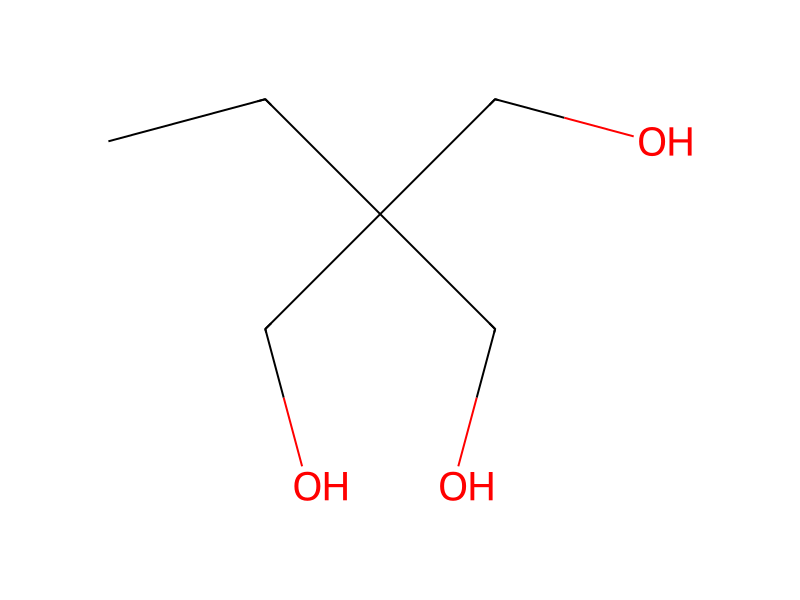
Butanal → Trimethylolpropane
Reaction equation

C(=O)CCC.C=O.[CH2:8]([C:10]([CH2:15][OH:16])([CH2:13][CH3:14])[CH:11]=[O:12])[OH:9]>>[CH2:8]([C:10]([CH2:15][OH:16])([CH2:11][OH:12])[CH2:13][CH3:14])[OH:9]Participants
4


Procedure
The hydrogenation process represents a further development. In this, butyraldehyde is reacted with formaldehyde in the presence of a catalytic amount of a tertiary amine. The reaction stops at the 2,2-dimethylolbutanal stage, and this product is subsequently hydrogenated to give trimethylolpropane. No stoichiometric amounts of formates are formed and the solution obtained is easier to work up since smaller amounts of interfering by-products are formed. Such a process is described, for example, in WO 98/28253. To achieve virtually complete conversion of the starting materials into dimethylolbutanal in this process, unreacted or partially reacted starting materials are separated off from the reaction mixture and returned to the aldol reaction step; the residue is treated catalytically and/or thermally to convert monomethylolbutanal into dimethylolbutanal and ethylacrolein, and the latter can be separated off and returned to the aldol reaction step. The crude TMP obtained by the process is worked up by distillation in a customary manner.