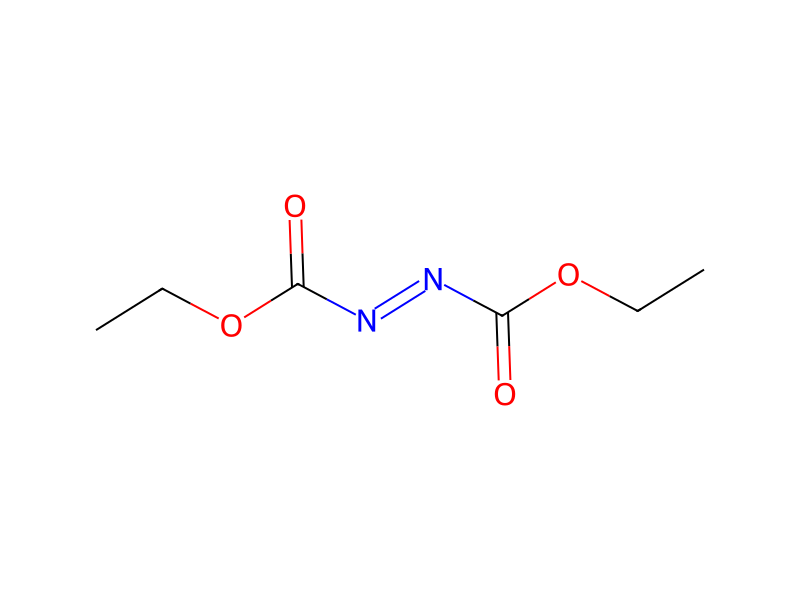
[O:1]=[S:2]1(=[O:12])[CH2:7][CH2:6][N:5]([CH2:8][CH2:9][CH2:10][OH:11])[CH2:4][CH2:3]1.[Cl:13][C:14]1[C:23]2[C:18](=[CH:19][C:20](O)=[C:21]([C:24]#[N:25])[CH:22]=2)[N:17]=[CH:16][CH:15]=1.C1(P(C2C=CC=CC=2)C2C=CC=CC=2)C=CC=CC=1.N(C(OCC)=O)=NC(OCC)=O>C(Cl)Cl>[Cl:13][C:14]1[C:23]2[C:18](=[CH:19][C:20]([O:11][CH2:10][CH2:9][CH2:8][N:5]3[CH2:6][CH2:7][S:2](=[O:1])(=[O:12])[CH2:3][CH2:4]3)=[C:21]([C:24]#[N:25])[CH:22]=2)[N:17]=[CH:16][CH:15]=13-(1,1-Dioxothiomorpholino)propan-1-ol (283 mg, 1.46 mmol) was added to a suspension of 4-chloro-6-cyano-7-hydroxyquinoline (200 mg, 0.97 mmol) in methylene chloride (30 ml), followed by the addition of triphenylphosphine (512 mg, 1.95 mmol) and a solution of diethyl azodicarboxylate (310 μl, 1.95 mmol) in methylene chloride (700 μl) in portions. After stirring for 5 minutes at ambient temperature, the volatiles were removed under vacuum. The residue was purified by column chromatography eluting with a mixture of methanol/ethyl acetate/methylene chloride (5/50/45). After combining the fractions containing the expected product, the solvents were removed under vacuum and the residue was triturated with methanol, collected by filtration, washed with methanol and dried under vacuum to give 4-chloro-6-cyano-7-(3-(1,1-dioxothiomorpholino)propoxy)quinoline (321 mg, 87%).