Reaction equation
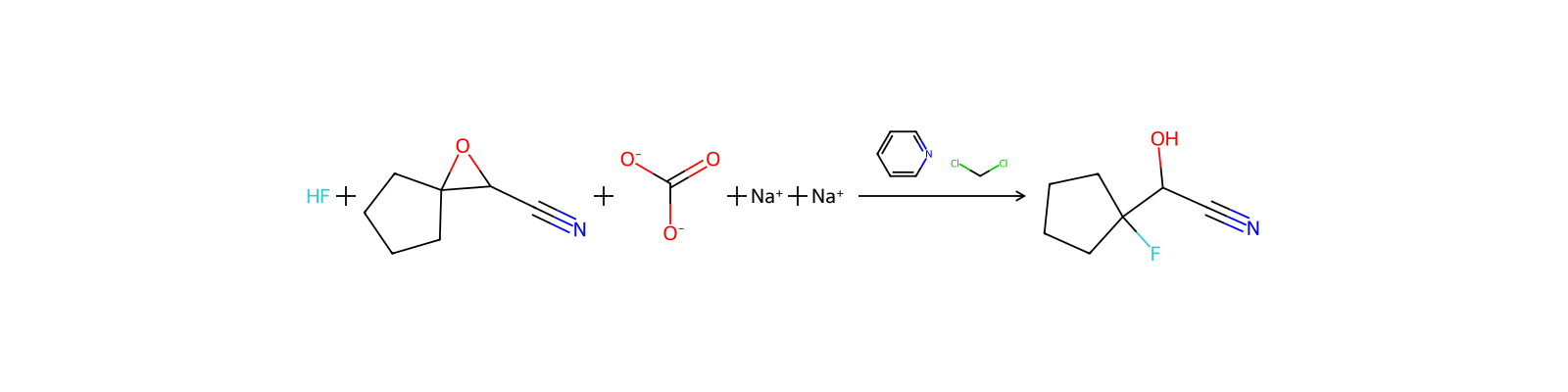
[FH:1].[O:2]1[C:4]2([CH2:8][CH2:7][CH2:6][CH2:5]2)[CH:3]1[C:9]#[N:10].C(=O)([O-])[O-].[Na+].[Na+]>N1C=CC=CC=1.ClCCl>[F:1][C:4]1([CH:3]([OH:2])[C:9]#[N:10])[CH2:8][CH2:7][CH2:6][CH2:5]1Participants
Reactant 4




Product 1

Reagents, catalysts & solvents 2


Conditions
- Temperature
- 0 °C
Procedure
Anhydrous dichloromethane (3 mL) and a 70% w/w solution of hydrogen fluoride (2.68 mL, 20.44 mmol) in pyridine are mixed in a polyethylene bottle at 0° C. under a nitrogen atmosphere. A solution of 1-oxa-spiro[2.4]heptane-2-carbonitrile (3.30 g, 26.76 mmol) in anhydrous dichloromethane (3.2 mL) is added slowly. The reaction is stirred at 0° C. for 1 h and at room temperature for 1 h. The mixture is cooled at 0° C. and a saturated solution of sodium carbonate is added carefully. The aqueous layer is extracted with diethyl ether. The organic layers are combined, washed with water and brine, dried over anhydrous sodium sulfate, filtered, and the solvent is removed. The residue is purified by chromatography in a 20 g silica gel cartridge eluting with hexane:diethyl ether (100:0 to 80:20) to obtain 1.7 g of desired compound as a colourless oil. 1H NMR (CDCl3) δ (ppm): 4.47 (d, 1H), 3.50 (bs, 1H), 2.12-1.67 (m, 8H).
Workup
- temperatureThe mixture is cooled at 0° C.
- extractionThe aqueous layer is extracted with diethyl ether
- washwashed with water and brine
- dry with materialdried over anhydrous sodium sulfate
- filtrationfiltered
- customthe solvent is removed
- customThe residue is purified by chromatography in a 20 g silica gel cartridge
- washeluting with hexane:diethyl ether (100:0 to 80:20)
Sources & evidence
- ORD record
- ord-4a95bf4964c24cd6be35cb541c2a2421
- Source dataset
- uspto-grants-2012_06
- Patent number
- US08207344B2
Linked notes
Loading…